Introduction
Jackals occur on all large non-polar landmasses other than Madagascar.
These are medium-size canids, centring on about 10 kg body mass, and with generalised diets including scavenging. Altogether we have seven species of jackals on Earth, if we include Australia as well as South America, and ‘shoehorn’ both the culpeo (Lycalopex culpaeus) and the dingo (Canis familiaris dingo) into the category of ‘jackal’.
Here I compare the various jackals pictorially, by presenting one carefully-chosen photo for each of these seven species, accompanied by concise annotation.
It is interesting that in the Americas all jackals were originally restricted to the western parts of the supercontinent, and that the jackal of North America was about twice as massive as that of South America.
Of all the species of jackals, it is L. culpaeus that shows the least individual variation in colouration, while C. adustus shows the most. This seems related to the fact that the predatory environment in the Andes is simple, compared with that in the central African woodlands.
Overall, in terms of colouration: whereas jackals of the Northern and Western Hemispheres are nondescript, those of sub-Saharan Africa have colouration that is not only complex, but so poorly understood that it is hard to classify as ‘cryptic’, ‘camouflaged’ or ‘conspicuous’ — and the dingo is odd in being colour-polymorphic.
One of the adaptive functions of the colouration of the two species of Lupulella, particularly L. adusta, seems to be to confuse the many species of large predators that threaten jackals in sub-Saharan Africa. Jackals survive by outwitting competitors and predators, and the colouration of the two sub-Saharan species is part of this outwitting.
The seven jackals
1Lycalopex culpaeus
Smallest jackal; cordillera of South America; extremely long tail; colouration nondescript except for dark tip to tail, with minimal individual variation.
Author’s photographView photograph
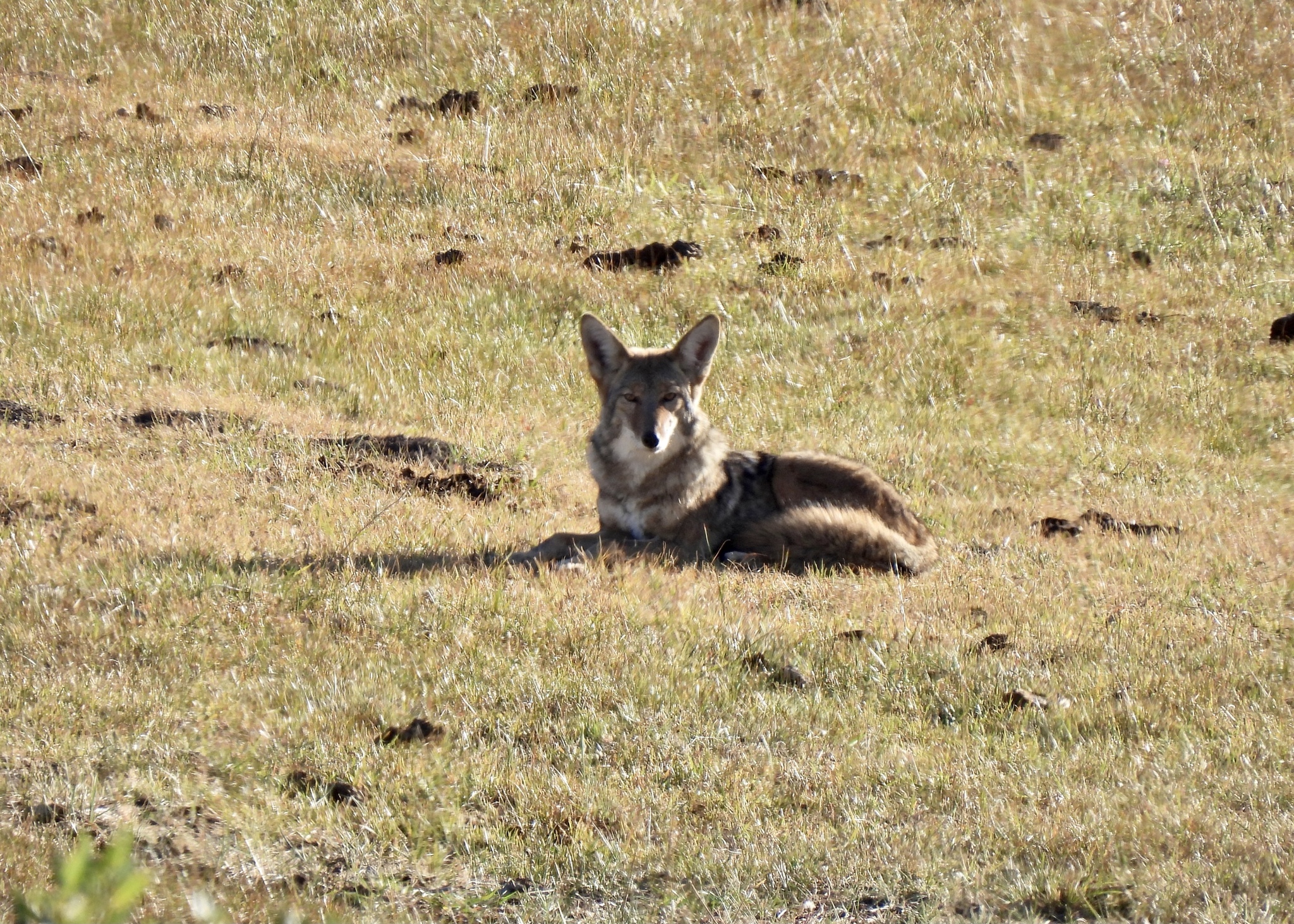
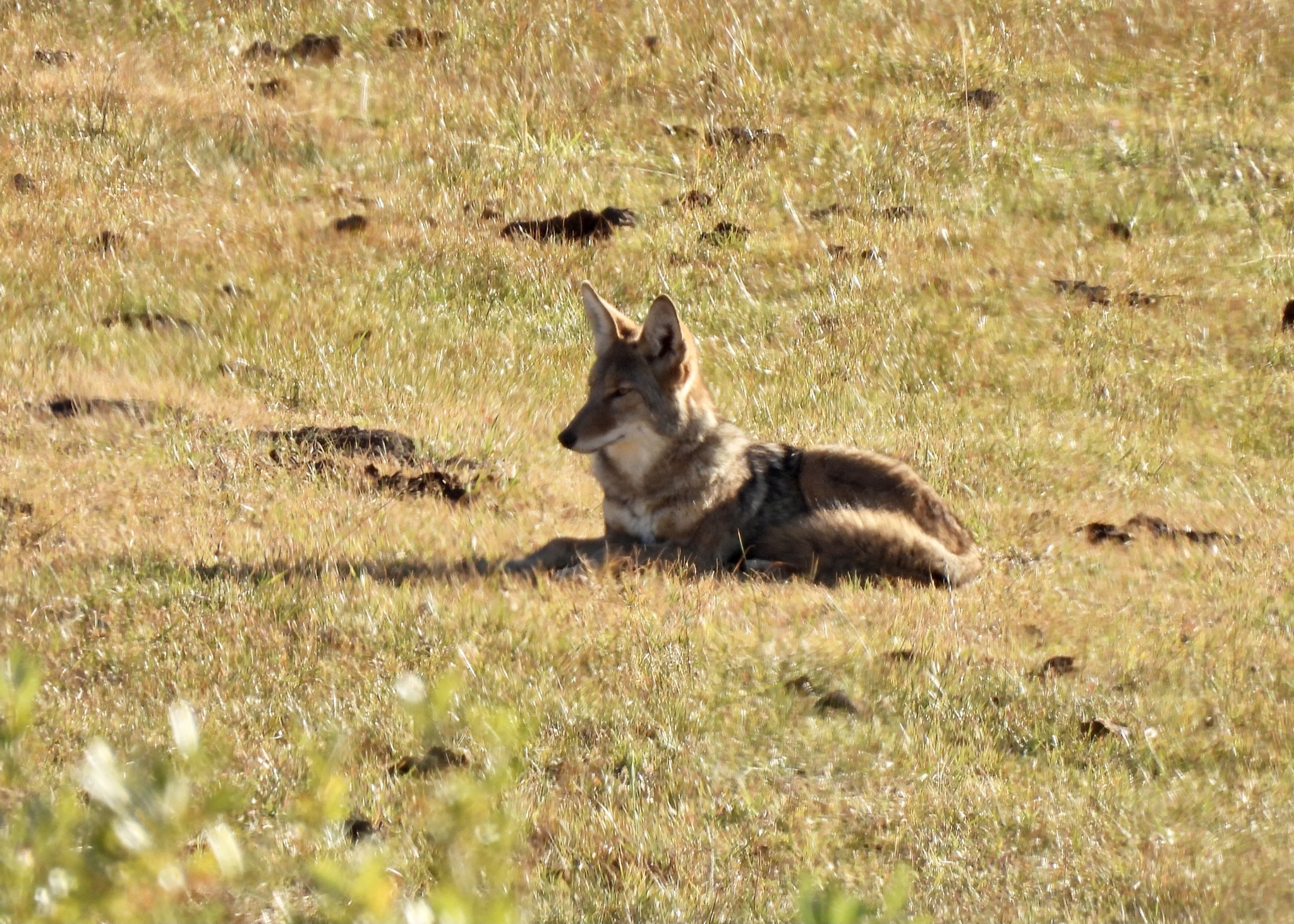
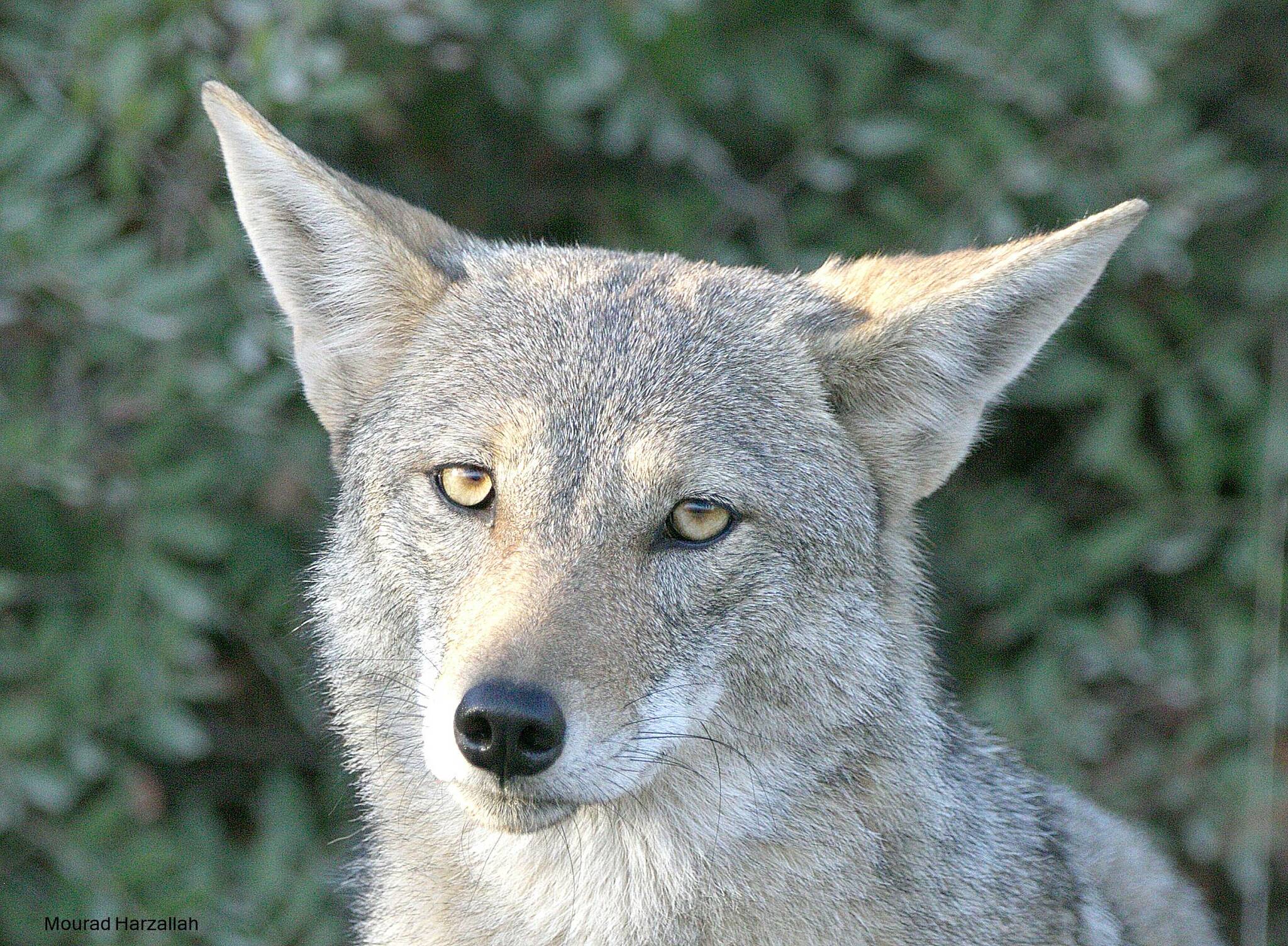
2Canis latrans
Largest jackal, together with the dingo; western half of North America; tail of normal length for a jackal; colouration nondescript.
Author’s photographView photograph (Kim Smith Designs)
3Canis aureus
Medium-size; Eurasia; tail short and ears small; colouration nondescript.
Author’s photographView photograph (Flickr)
4Canis anthus
Medium-size; North Africa; tail of normal length for a jackal; colouration nondescript.
Author’s photographView photograph
5Lupulella adusta
Medium-size; sub-Saharan Africa; tail long and head small; colouration confusingly variable individually; conspicuous dark–pale contrast on tail and hindquarters.
Author’s photographView photograph
6Lupulella mesomelas
Relatively small; dry parts of sub-Saharan Africa; tail of normal length for a jackal; conspicuous dark–pale contrast on flanks.
Author’s photographView photograph (Wikimedia Commons)
7Canis familiaris dingo
Largest jackal, together with the coyote; Australasia and south-east Asia; tail short for a jackal; head large; colour-polymorphic, with a greater tendency to an ischial flag than in any other jackal.
Author’s photographView photograph (The Conversation)
Remarkable differences among jackal species in fang-baring
Richard Estes, in his Behavior Guide to African Mammals (1991), mentions that the coexisting jackals Canis anthus and Lupulella mesomelas differ in their fang-baring (a term he does not use). This turns out to be consistent at a generic level, between Canis and Lupulella.
This difference can be illustrated in Canis aureus versus Lupulella mesomelas. The former is similar to the wolf (Canis lupus) and the coyote in its fang-baring expression, whereas Lupulella mesomelas is relatively expressionless.
This difference among Canidae parallels differences among Felidae, particularly lynxes. Even closely similar carnivores can differ in their fang-baring behaviour — and perhaps the anatomical structures that permit such displays.
Canis aureus — 19 photographs1·2·3·4·5·6·7·8·9·10·11·12·13·14·15·16·17·18·19
The two subspecies of Lupulella mesomelas
The two subspecies can easily be identified by their faces. The East African subspecies, schmidti, has underscored cheekbones and a small muzzle. The ear pinnae also differ in shape and relative size.
Rights reserved — linked onlyobs. 68221755 (Craig Minkley)
Also cited for the two subspeciesmesomelas (Alamy)·schmidti (Alamy)·schmidti (Shutterstock)
Colour-morphs of the dingo
Illustrations of the ‘black-and-tan’ colour-morph in adults of the dingo, and of the New Guinea singing dog.
Author’s illustrations1·2·3·4·5·6·7·8·9·10
Braininess in jackals
The various species of jackals vary remarkably in braininess, according to data presented in Gittleman (1986) and Smith et al. (2017). In decreasing order of encephalisation quotient:
| Species | EQ |
|---|---|
| Canis latrans | 1.53 |
| Canis aureus | 1.42 |
| Canis familiaris dingo | 1.37 |
| Lupulella mesomelas | 1.22 |
| Lycalopex culpaeus | ~1.19 |
| Lupulella adusta | 0.86 |
The average mammal, by definition, has EQ = 1.0. Most species of jackals are considerably brainier than the average mammal (including most members of the Felidae), with the coyote so encephalised that it may exceed the wolf in braininess.
It is somewhat surprising that the dingo is as brainy as it is, given that it is nominally a ‘deeply feral’ form of the domestic dog, a species generally recognised to be decephalised relative to its wild ancestors. In terms of its braininess, the dingo seemingly functions like a true jackal, despite having passed through an anthropogenically modified stage in its evolution.
It is also surprising that genus Lupulella is less brainy than genus Canis. The black-backed jackal has the same reputation as the coyote for wiliness in the face of human persecution, yet its EQ does not rival even that of the dingo. In the case of the side-striped jackal, not only is it the least brainy of the jackals, it is actually considerably below par for a mammal in general.
Notes from Kingdon, and from Skinner & Smithers
- All three species in sub-Saharan Africa have body mass about 10 kg.
- In north-eastern Africa, L. mesomelas schmidtii is confined to acacia savannas; in semi-desert and treeless grassland it is replaced by Canis anthus.
- In south-western Africa, L. m. mesomelas spans acacia savannas and other vegetation types, suggesting ‘ecological release’.
- L. adusta is absent from the forest block of central and West Africa; it extends to high altitudes and the urban area of Harare, and is more strictly nocturnal than L. m. mesomelas.
- Both L. adusta and Canis aureus are commensal.
- L. adusta eats the fleshy fruits of Ficus, Parinari, Uapaca, Diospyros and Grewia, and Dorylus nymphs and termite alates.
Discussion in the comments
A reader noted the difficulty of distinguishing the North American Canis latrans from C. lupaster of Africa when no locality is given.