
The seriesPart 1·Part 2·Part 3·Part 4
…continued from
The most obvious ‘dwarfing’ of ebonies in southern Africa belong to the genus Euclea (see my last Post).
This is because Euclea:
- is, unlike its cosmopolitan relative Diospyros, restricted to Africa and Arabia,
- tends to be shrubby even in its most arborescent forms,
- is nowhere species-richer than in southern Africa, and
- penetrates the winter-rainfall climates of South Africa in the cases of at least nine species, four of which are completely restricted to these climates.
However, confamilial Diospyros – an exceptionally widespread and speciose genus globally (Wikipedia) – also participates in the syndrome of dwarf ebonies to a surprising degree. This is partly because Diospyros is incomparably more widespread and ecologically differentiated in southern Africa than on climatically analogous landmasses.
Three forms of Diospyros in South Africa qualify as dwarf ebonies:
- Diospyros glabra in mesic fynbos throughout the southwestern Cape,
- Diospyros austro-africana in various vegetation types from the southwestern Cape through the Great Karoo to the Highveld, and
- Diospyros scabrida var. cordata in certain types of scrubby vegetation (other than fynbos and succulent thicket) in the Eastern Cape.
In all three cases the plants tend to be low shrubs associated with rocky substrates (see the following for an extreme example):
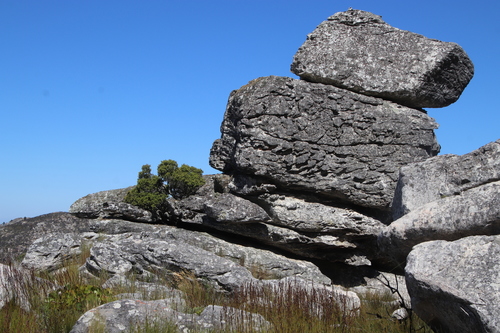
None of these species is genotypically dwarfed to the degree seen in e.g. Euclea tomentosa, E. acutifolia and E. polyandra, because all can grow several meters high where protected from wildfire.
Nor can any species of Diospyros be called sclerophyllous. Euclea becomes sclerophyllous rather than small-leafed where the whole plant is diminutive. Although the foliage is also adapted in the case of Diospyros, the leaves of dwarf ebonies of this genus are reduced in size rather than being lignified.
Diospyros glabra (iNaturalist) is restricted to the acidic soils of the heartland of the Cape Floristic Region (Wikipedia), part of which is in a winter-rainfall climate. It has penetrated fynbos more deeply than has any species of Euclea, and it seems to be more adapted to a regime of frequent wildfires than is any other species of dwarf ebony:
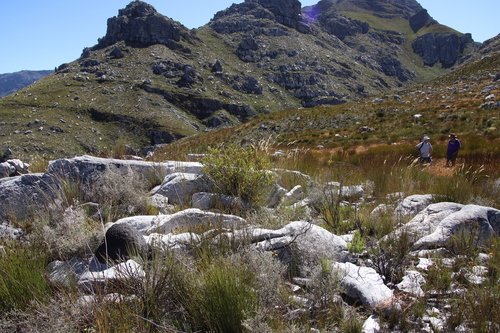
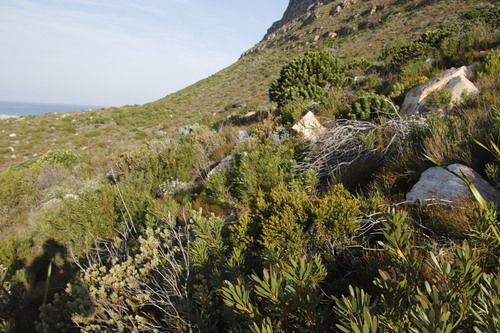
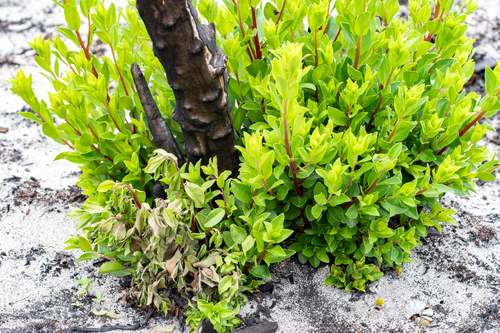
What this means is that Diospyros glabra is the prime example of an ebony exclusive to the Cape Flora. There is no similar plant in any analogous flora of nutrient-poor, fire-prone environments elsewhere on Earth (see kwongan).
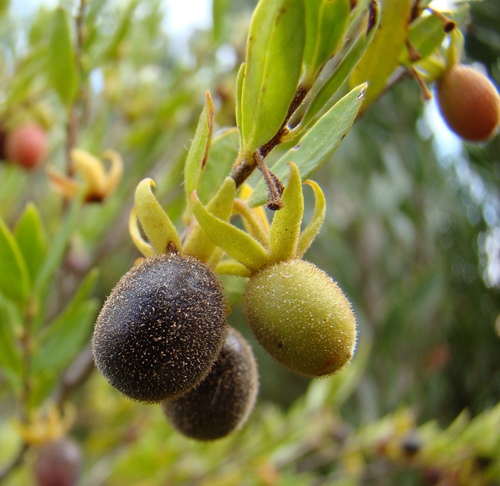
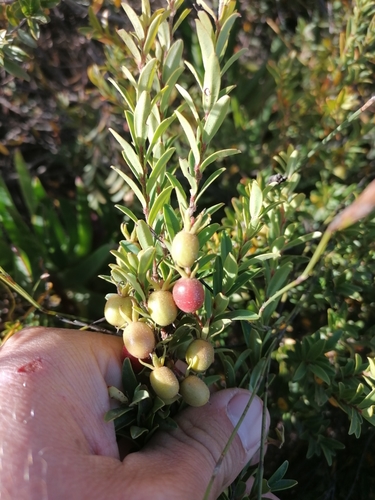
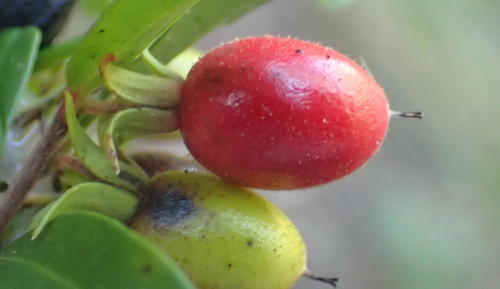
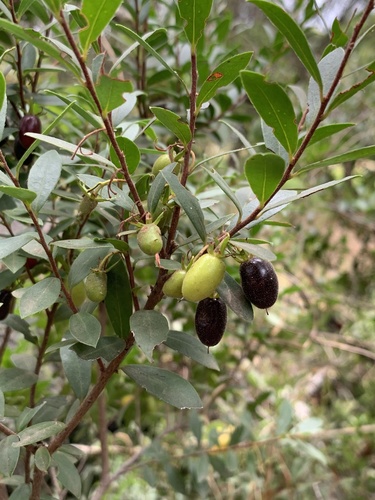
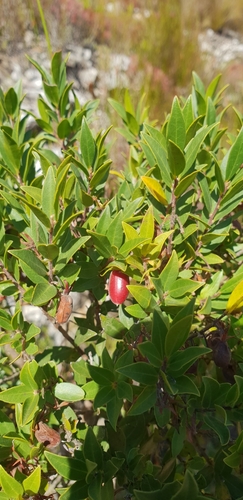
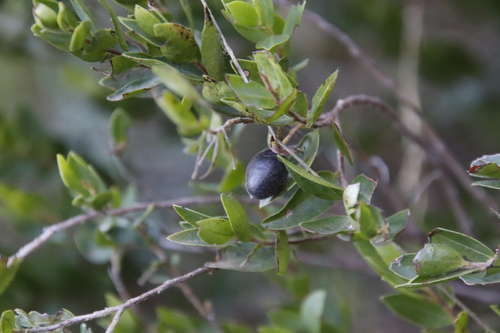
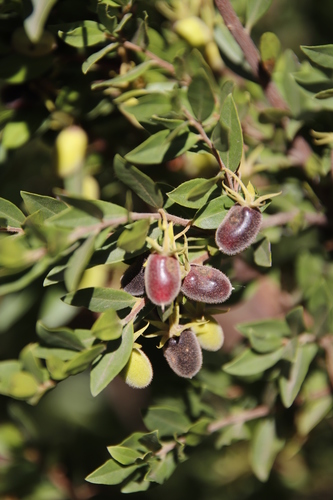
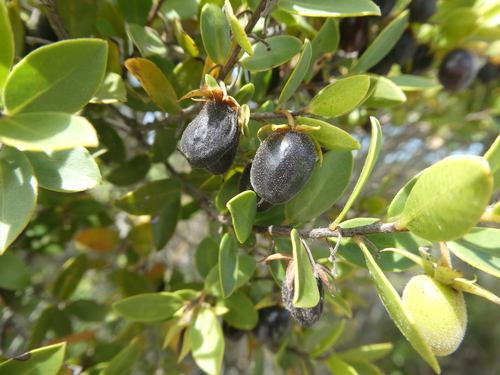
The only feature of D. glabra that remains incongruous with fynbos is its fleshy fruit, attractive to seed-dispersing birds:
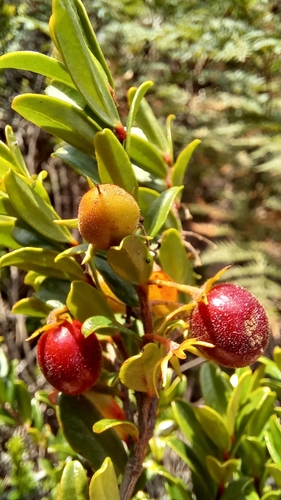
Citedscholar.ufs.ac.za
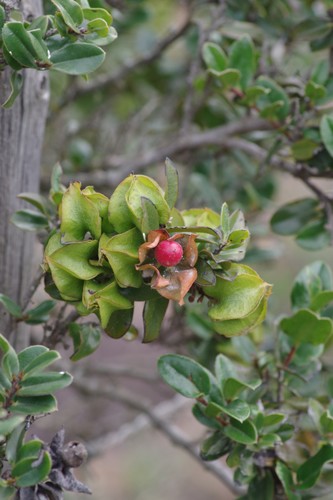
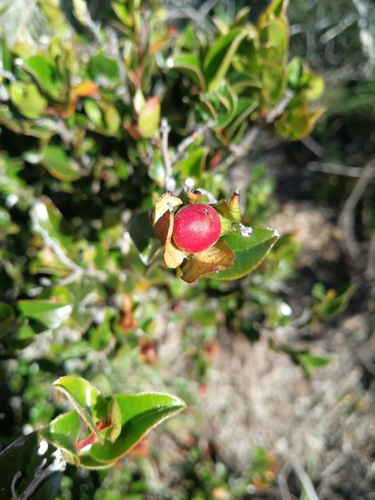
More illustrations of Diospyros glabra:
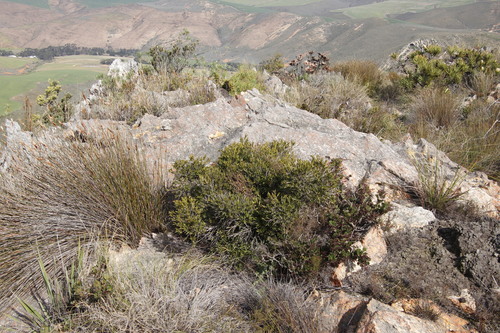
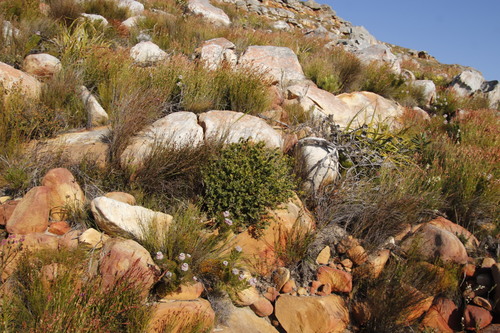
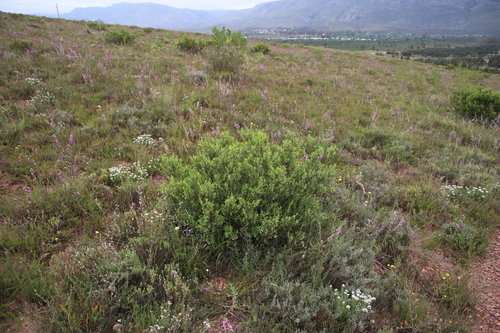
It occurred to me that Diospyros glabra might be regarded as the biogeographical and ecological equivalent of Vaccinioideae, a tribe of Ericaceae notably absent from the Cape Flora and most of Africa. However, this idea did not stand up to scrutiny.
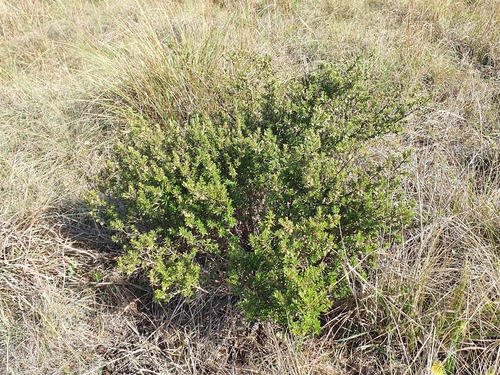
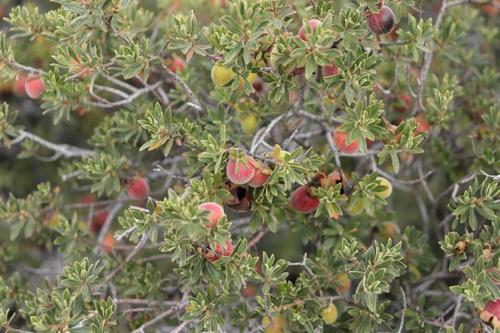
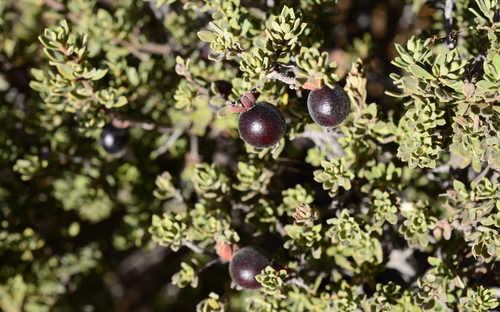
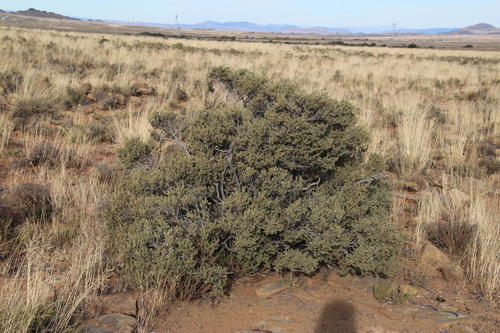
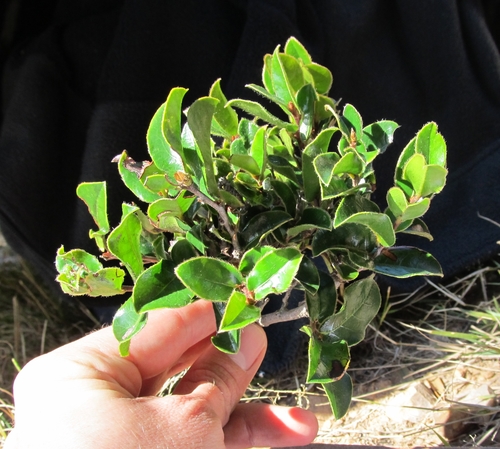
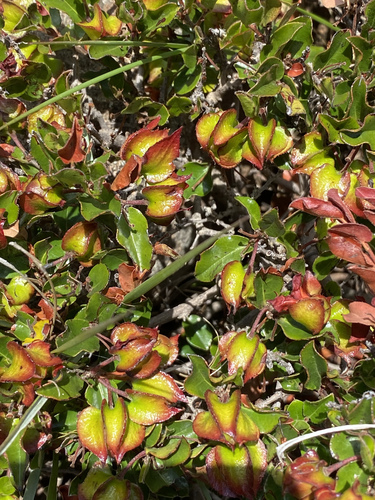
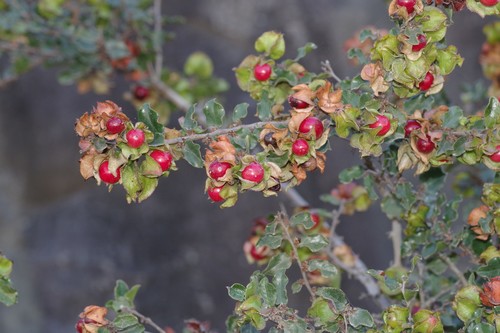
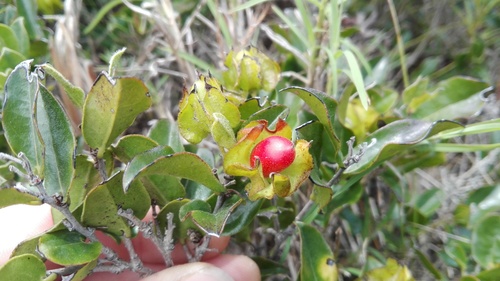
The following illustrate Diospyros austro-africana (iNaturalist), which has possibly the smallest leaves of any member of this genus worldwide:
The following illustrate Diospyros scabrida var. cordata (iNaturalist):
It is easy for South African naturalists to take for granted the floristic integration of Diospyros into various types of low vegetation. However, the oddness of this emerges from comparison with other landmasses having similar latitudes and climates.
South America is extremely different from Africa in the incidence of Diospyros. Not only is there no counterpart for dwarf ebonies, but most of South America at the latitudes of South Africa lacks Diospyros completely.
North America has a few species (see Diospyros virginiana) of Diospyros at the latitudes of South Africa, but none is comparable with dwarf ebonies.
In Australia there are 12 indigenous species of Diospyros, the most southerly of which (Diospyros australis) reaches as far south as the southern tip of South Africa. However, this species is restricted to the east coast, and all but the eastern and northern 5% of Australia is naturally devoid of this genus.
Citedjstor.org
Despite the many floristic links among southern continents, no species of Ebenaceae occurs in any Australian (or South American) biome comparable with those described above in South Africa.
In partial summary, all continents and subcontinents ecologically comparable with the southwestern parts of South Africa have a negligible indigenous incidence of Diospyros.
Therefore the exceptional nature of southern Africa with reference to dwarf ebonies applies to Diospyros as much as to Euclea. The intercontinental difference is categorical in the sense that dwarf ebonies are exclusively southern African.
to be continued in Part 4…
The author added the following in comments beneath the original post.
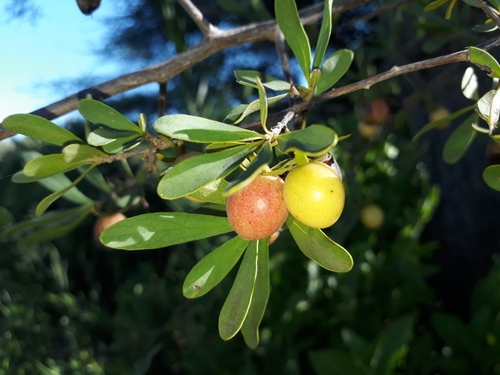
Pre-ripe display in Diospyros lycioides:
A further observation, cited without comment: