
The seriesPart 1 (on iNaturalist)·Part 2 (on iNaturalist)·Part 3·Part 4
…continued from
CitedRelated post
INTRODUCTION
In general, cervids are more likely than bovids to display the tail in antipredator contexts.
CitedWikipedia 1·Wikipedia 2
This applies to a comparison with the cervid perhaps most comparable to reedbucks, viz. Hyelaphus porcinus (https://www.inaturalist.org/taxa/1059869-Axis-porcinus-porcinus and ) of the Indian subcontinent.
Citedalchetron.com
AIMS
This part of our series compares H. porcinus with reedbucks in terms of the colouration and display of the tail.
CitedDreamstime
COMPARABILITY OF HYELAPHUS PORCINUS WITH REDUNCA SPP.
The intercontinental analogy invoked here is, at best, approximate. However, it is sufficient to aid our understanding of the anatomy and behaviour of reedbucks.
Hyelaphus porcinus resembles reedbucks in the following ways:
- body masses are similar,
- gregariousness is limited,
- sexual dimorphism is moderate,
- colouration is plain, conforming to ‘background-matching’ with grassy vegetation,
- the habitats tend to provide tall grass as cover, and
- diets consist mainly of grass.
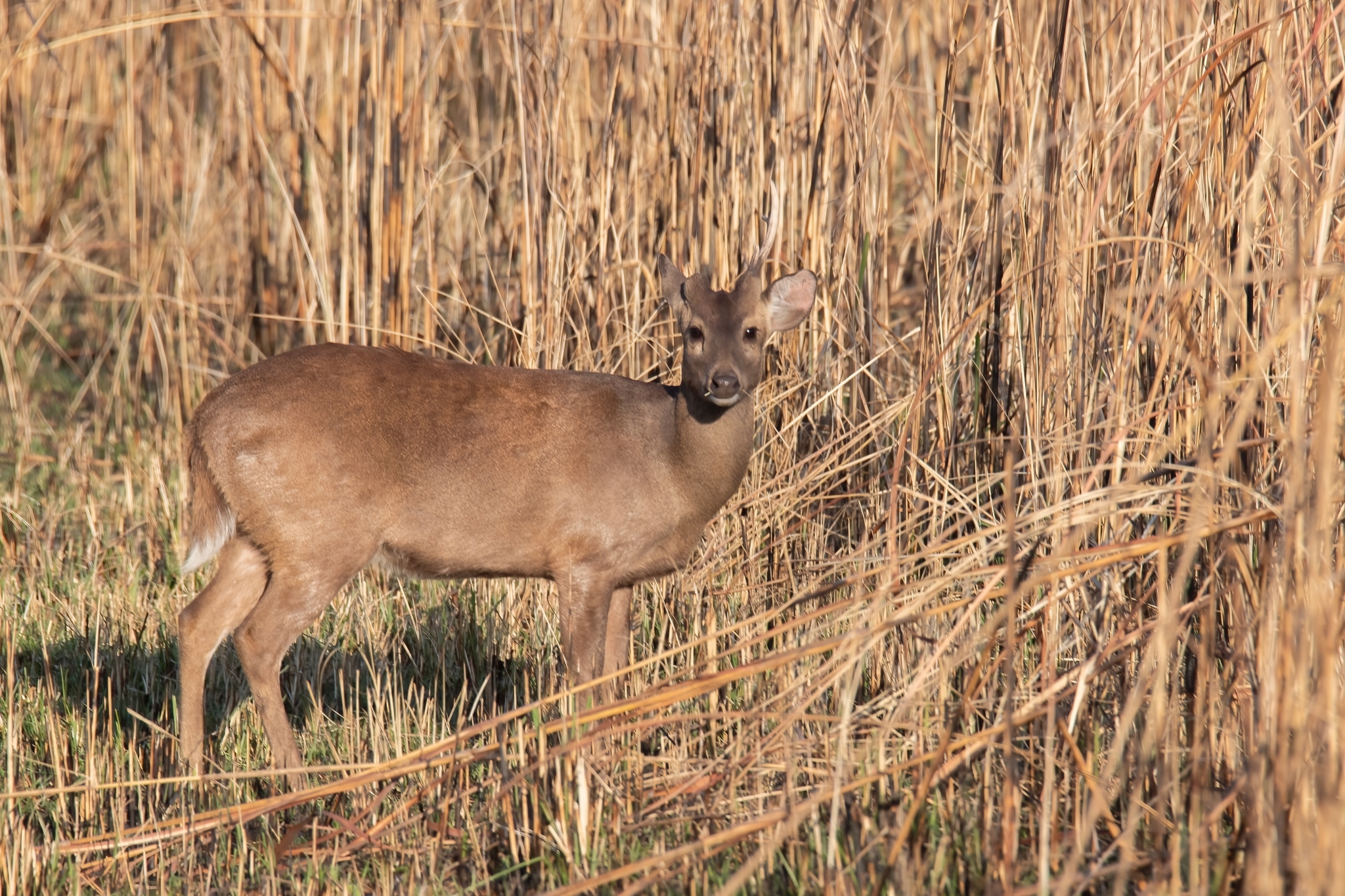
CitedDreamstime·iStock 1·iStock 2·iStock 3
However, H. porcinus differs from reedbucks in the following ways:
- the legs are proportionately short,
- fleeing is by ‘scurrying’ instead of with a ‘rocking-horse’ motion,
- the eyes are proportionately small,
- gregariousness is greater and more sexually dimorphic,
- more seasonally variable in colouration, and
- the habitat is more subject to seasonal inundation.
Also cited on iNaturalistobs. 148178350
CitedAlamy·iStock 1·iStock 2·naturepl.com·iStock 3·Adobe Stock 1·Adobe Stock 2·cnbctv18.com·bbc.com
RESULTS
Hyelaphus porcinus resembles reedbucks in the anatomy and colouration of the tail and buttocks:
- the ventral side of the tail bears long white pelage,
- the dorsal side of the tail has a white tip, and
- the inner (medial), upper buttocks bear short white pelage.
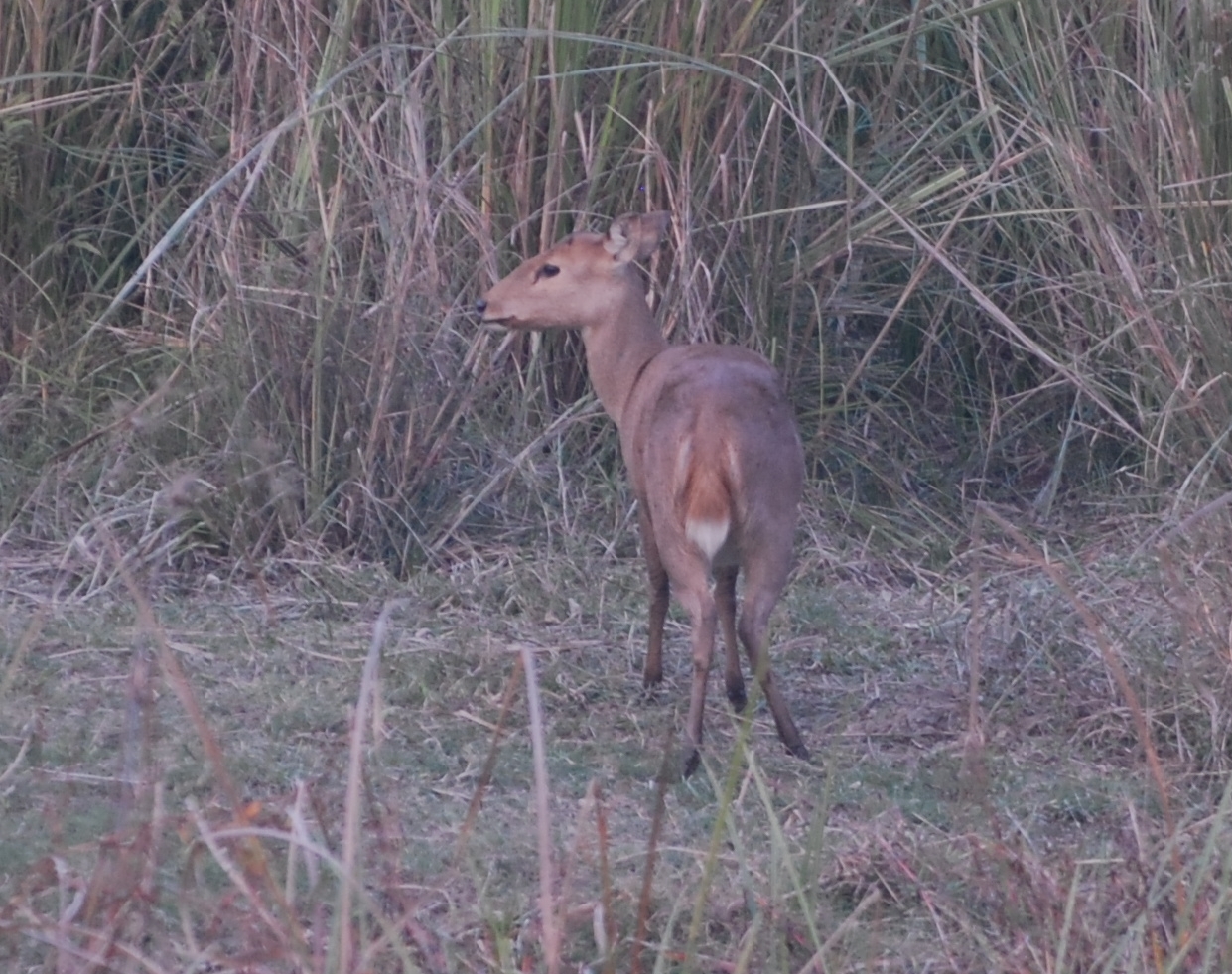
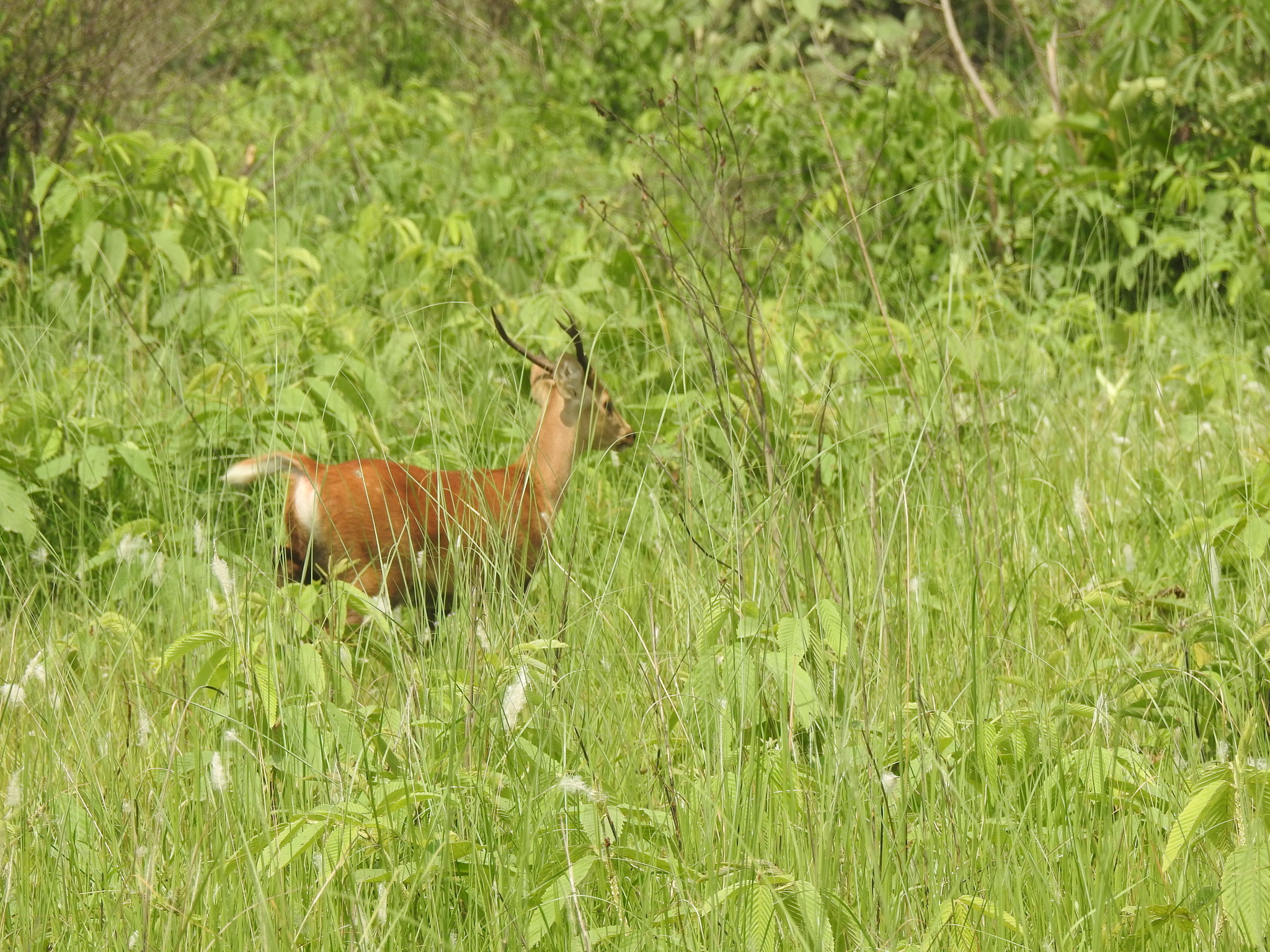
CitedDreamstime·Alamy·iStock
This certainly qualifies as a caudal flagg.
The tail of H. porcinus is
- similar in shape to that if Redunca redunca, and narrower than those of Redunca arundinum and Redunca fulvorufula, and
- proportionately larger in females than in males.
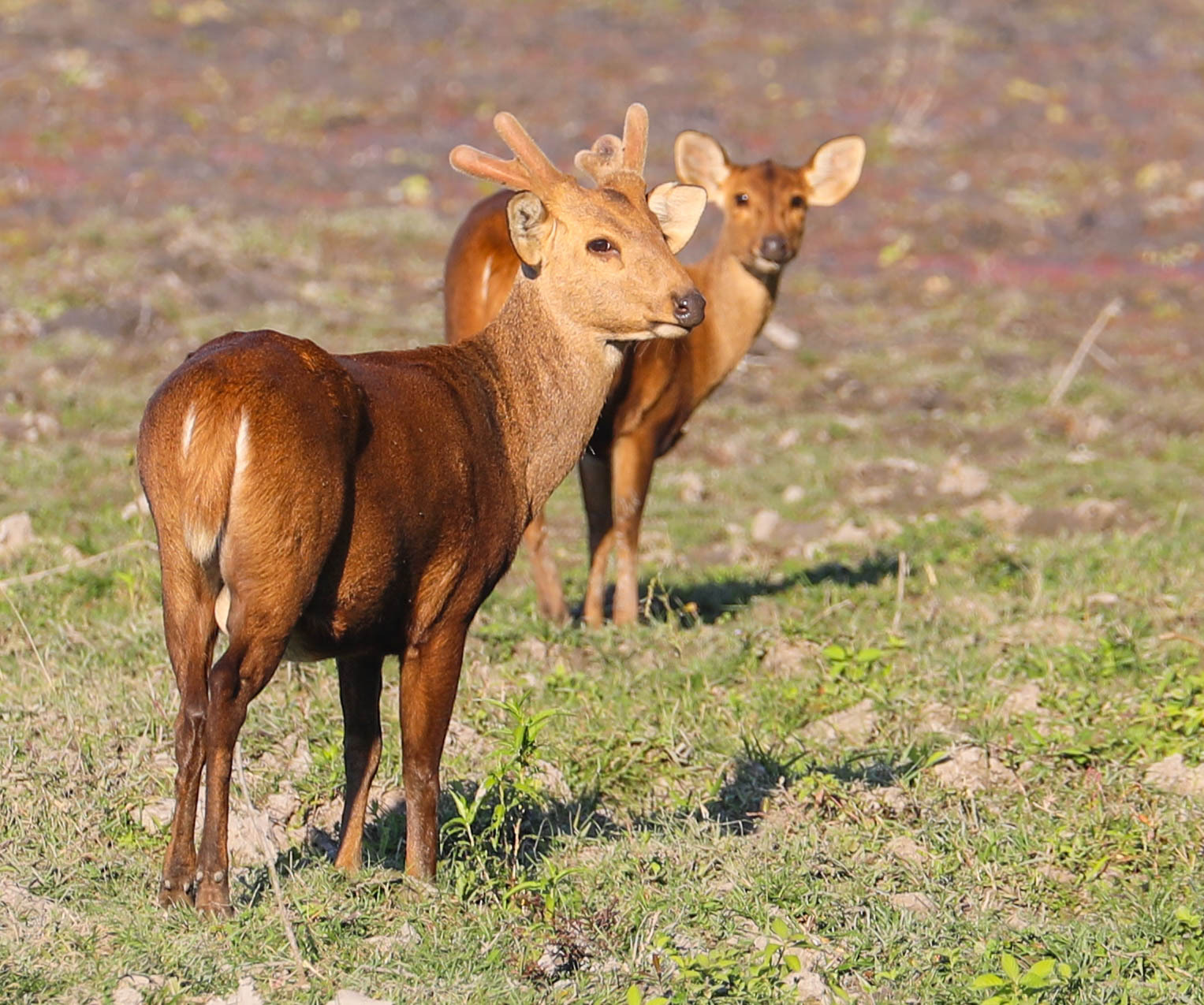
CitedAdobe Stock 1·Adobe Stock 2
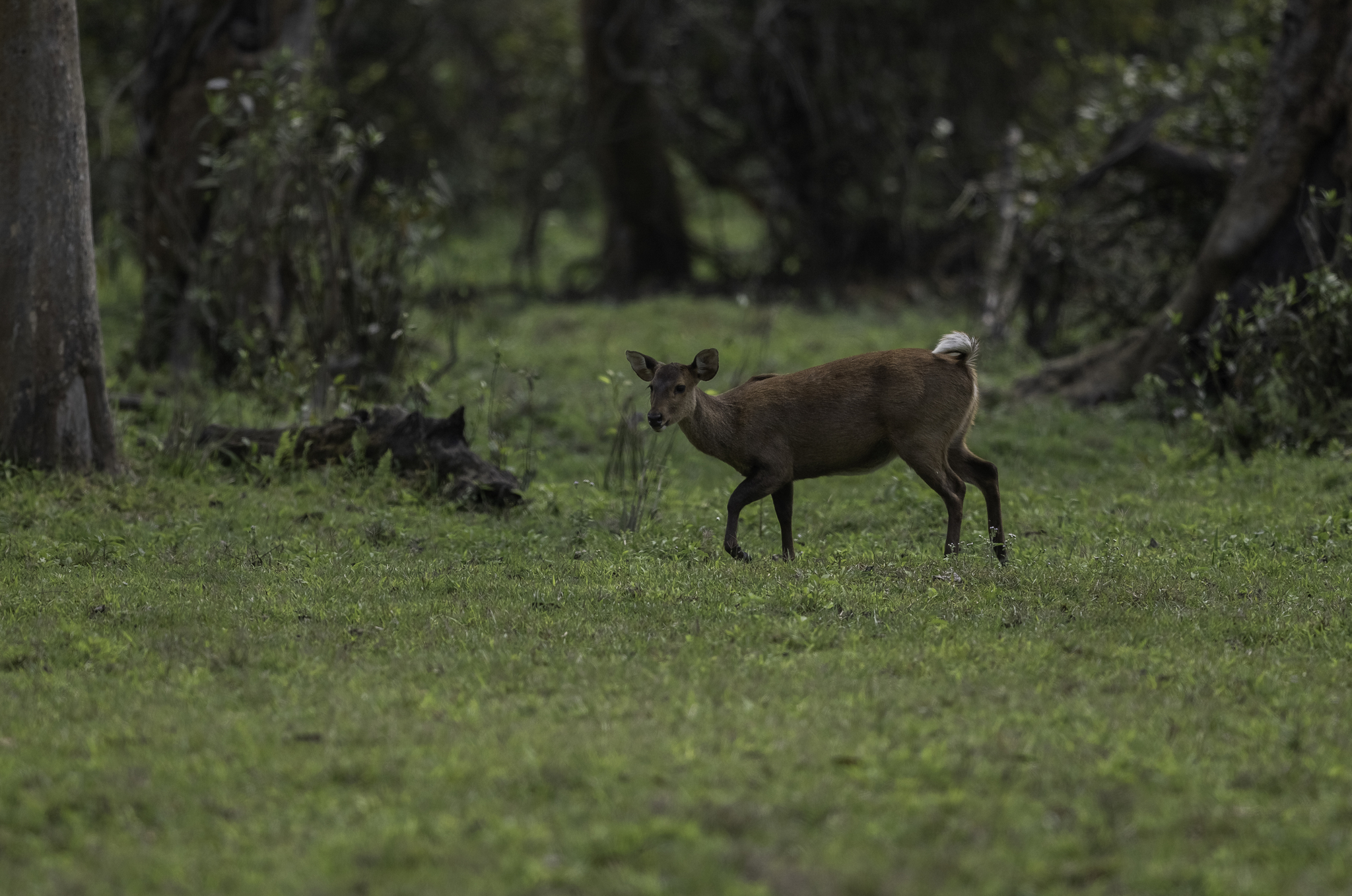
Unlike reedbucks, H. porcinus tends to erect the tail in antipredator contexts:
Also cited on iNaturalistobs. 58693266
CitedShutterstock·Alamy 1·observation.org·Alamy 2·instagram.com·Adobe Stock
However, this flagging
- occurs in juveniles more than in adults,
- is variable rather than stereotyped, and
- occurs mainly before, rather than during, fleeing.
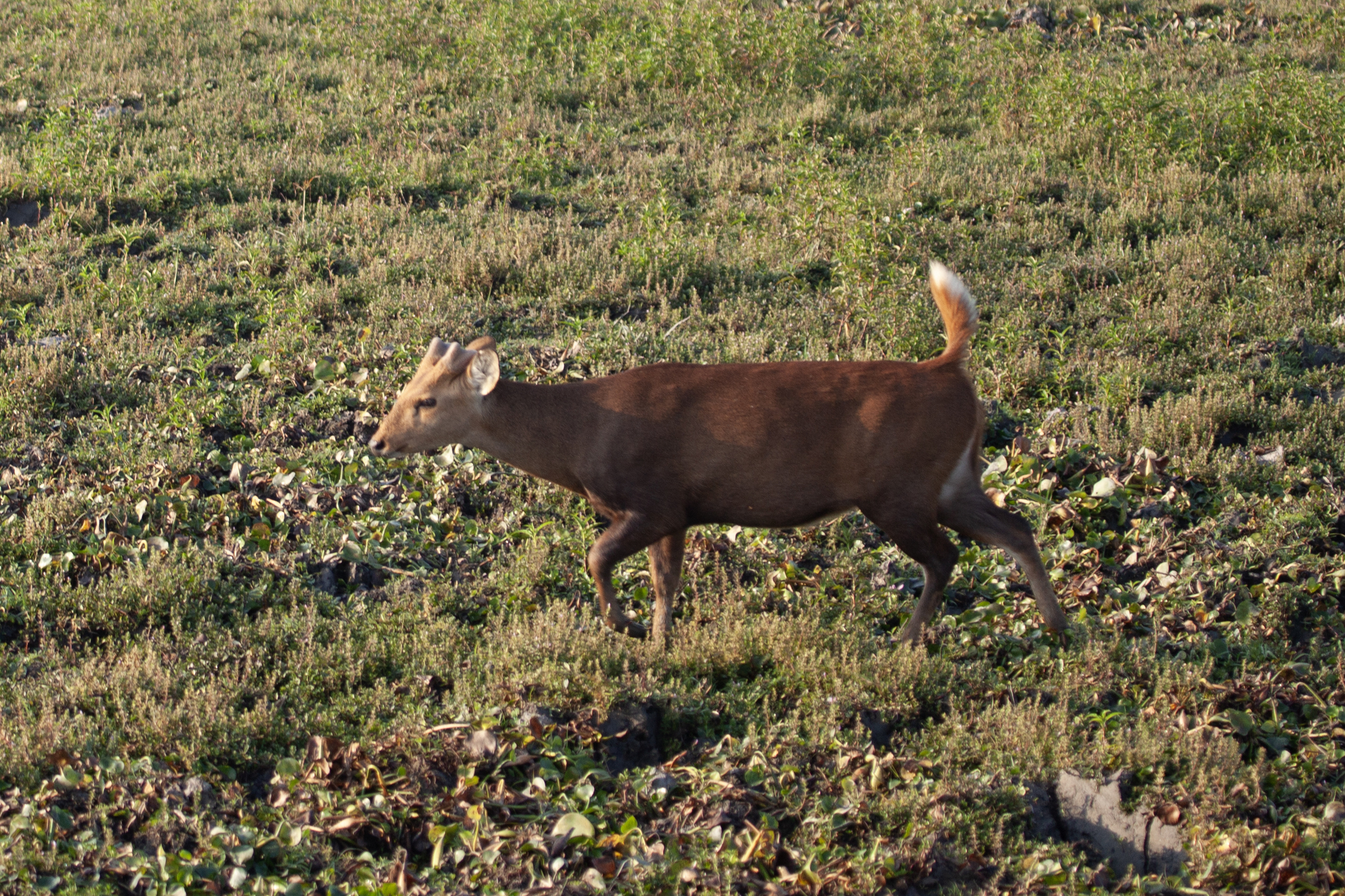
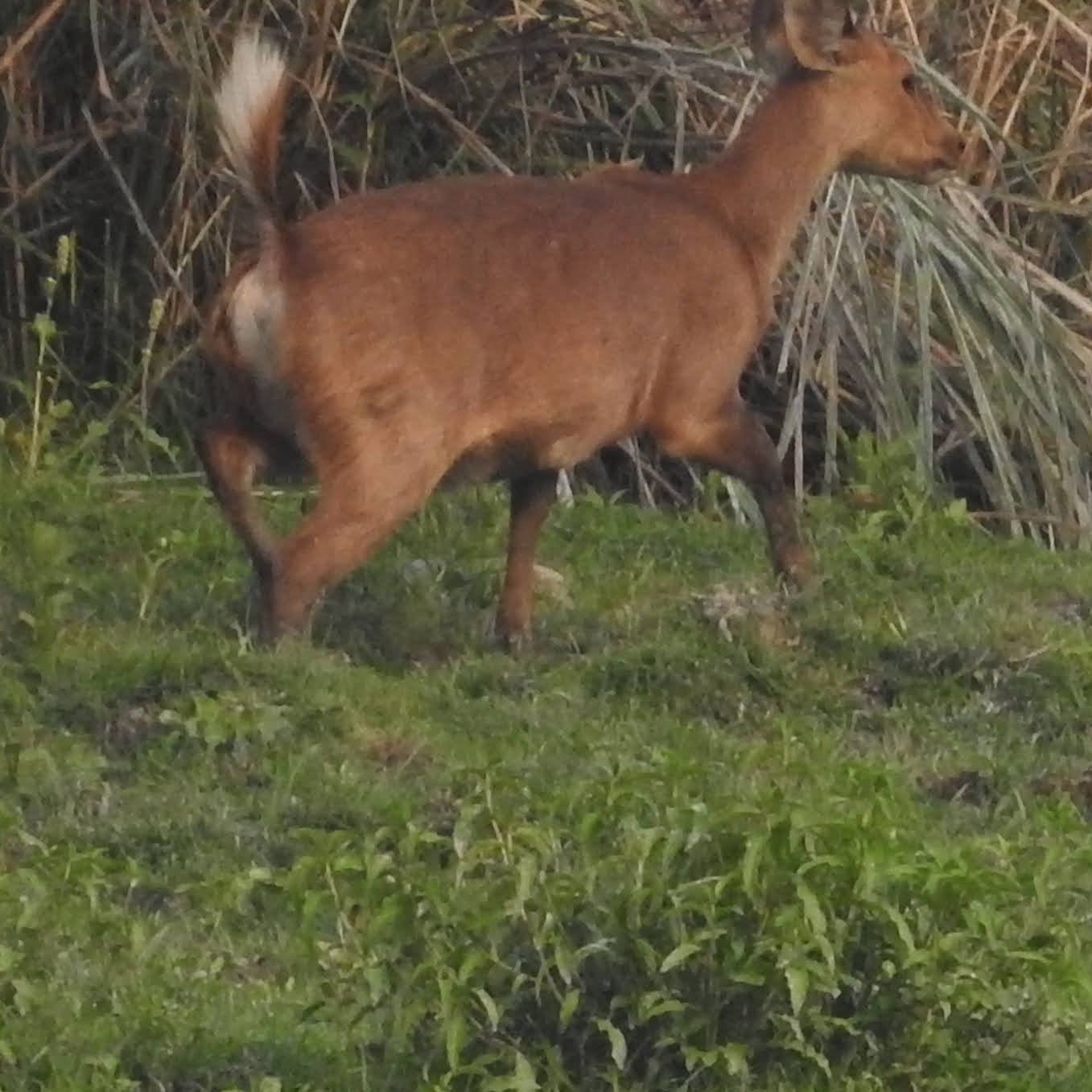
CitedYouTube 1·YouTube 2·iStock 1·Adobe Stock·iStock 2·iStock 3·iStock 4·iStock 5·YouTube 3
DISCUSSION
The adaptive colouration of Redunca arundinum and Redunca redunca is about as simple as that of any ruminant of similar body size. It consists of
- ‘background-matching’,
- countershading,
- a caudal flagg, and
- a buccal semet.
In H. porcinus, adaptive colouration paradoxical in a subtle way.
This is because
- the overall effect during both seasons is inconspicuous.
CitedAdobe Stock 1·Adobe Stock 2·Adobe Stock 3
However, countershading is replaced – particularly in mature males – by dark ventral emphasis.
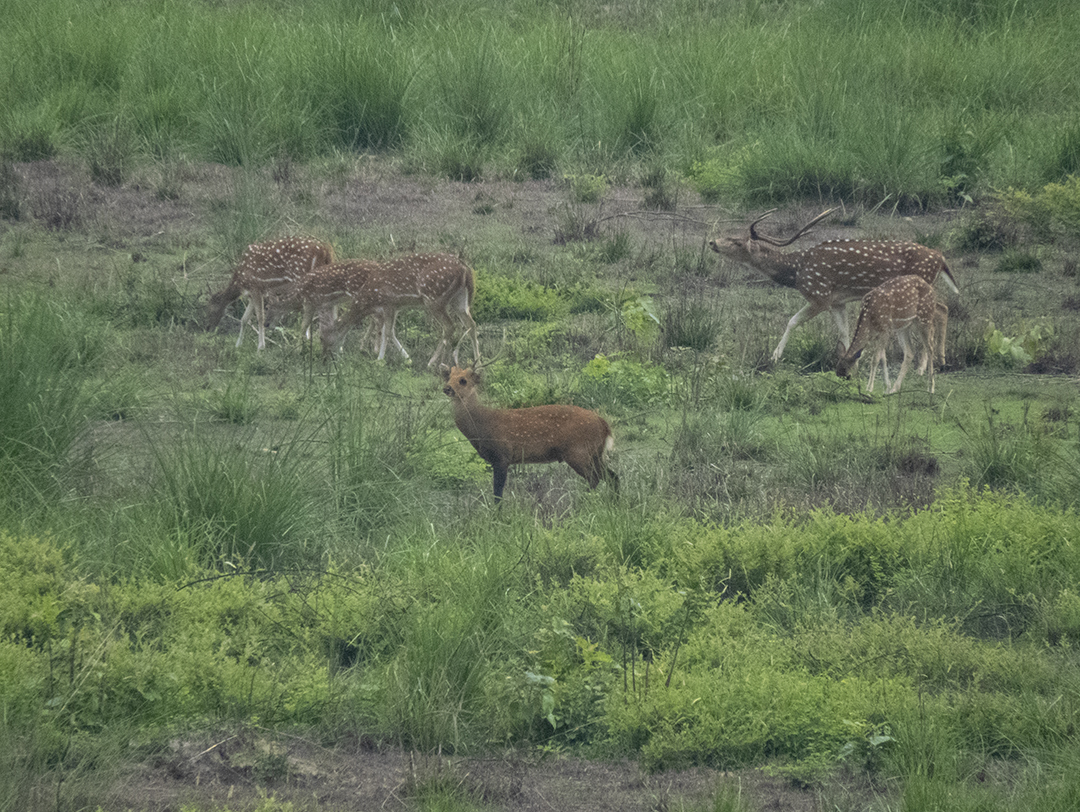
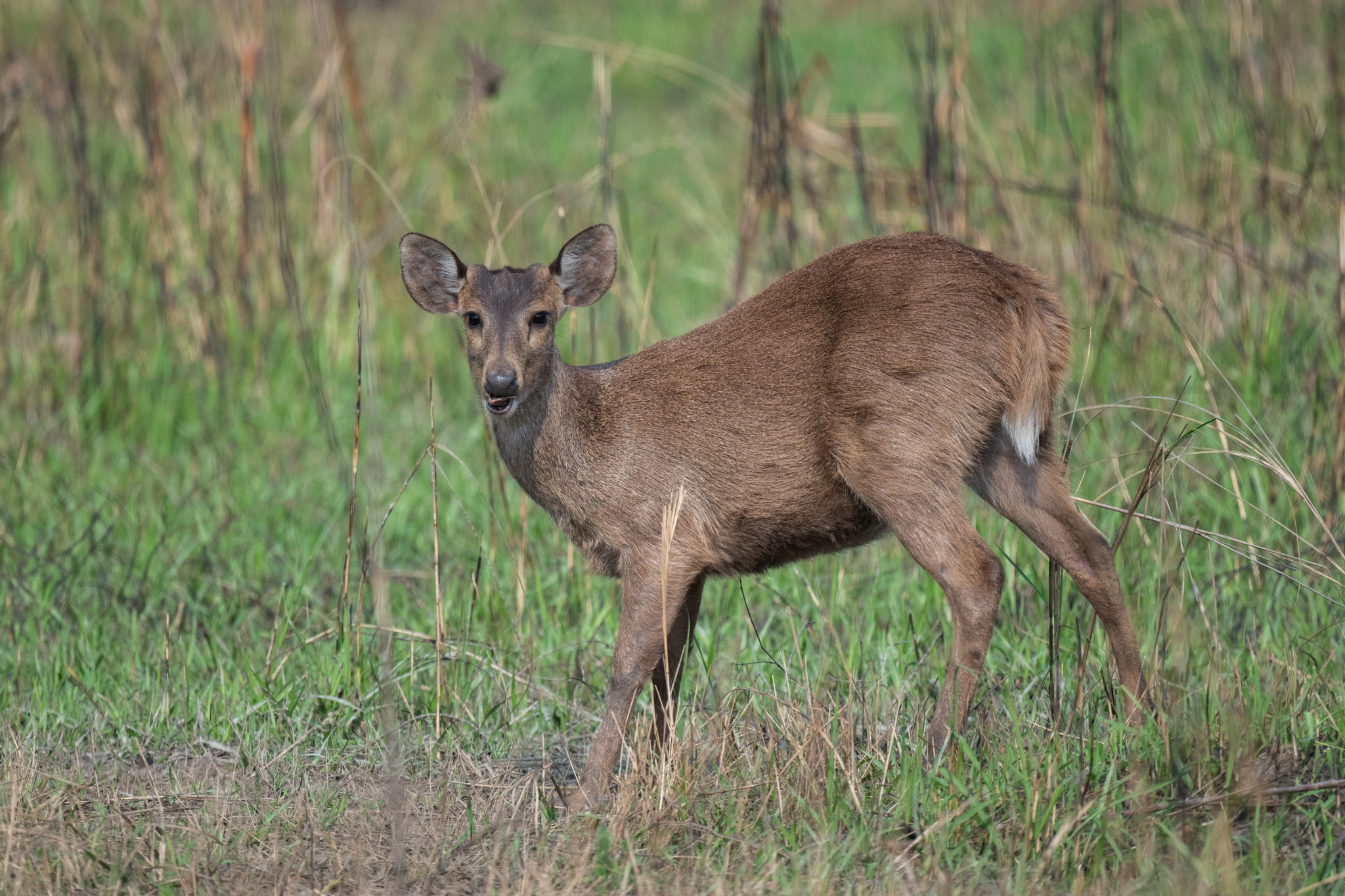
Also cited on iNaturalistobs. 201927699
CitedDreamstime
See from about 20 seconds in
CitedYouTube
Citedpestsmart.org.au·animaldiversity.org
CitedAdobe Stock
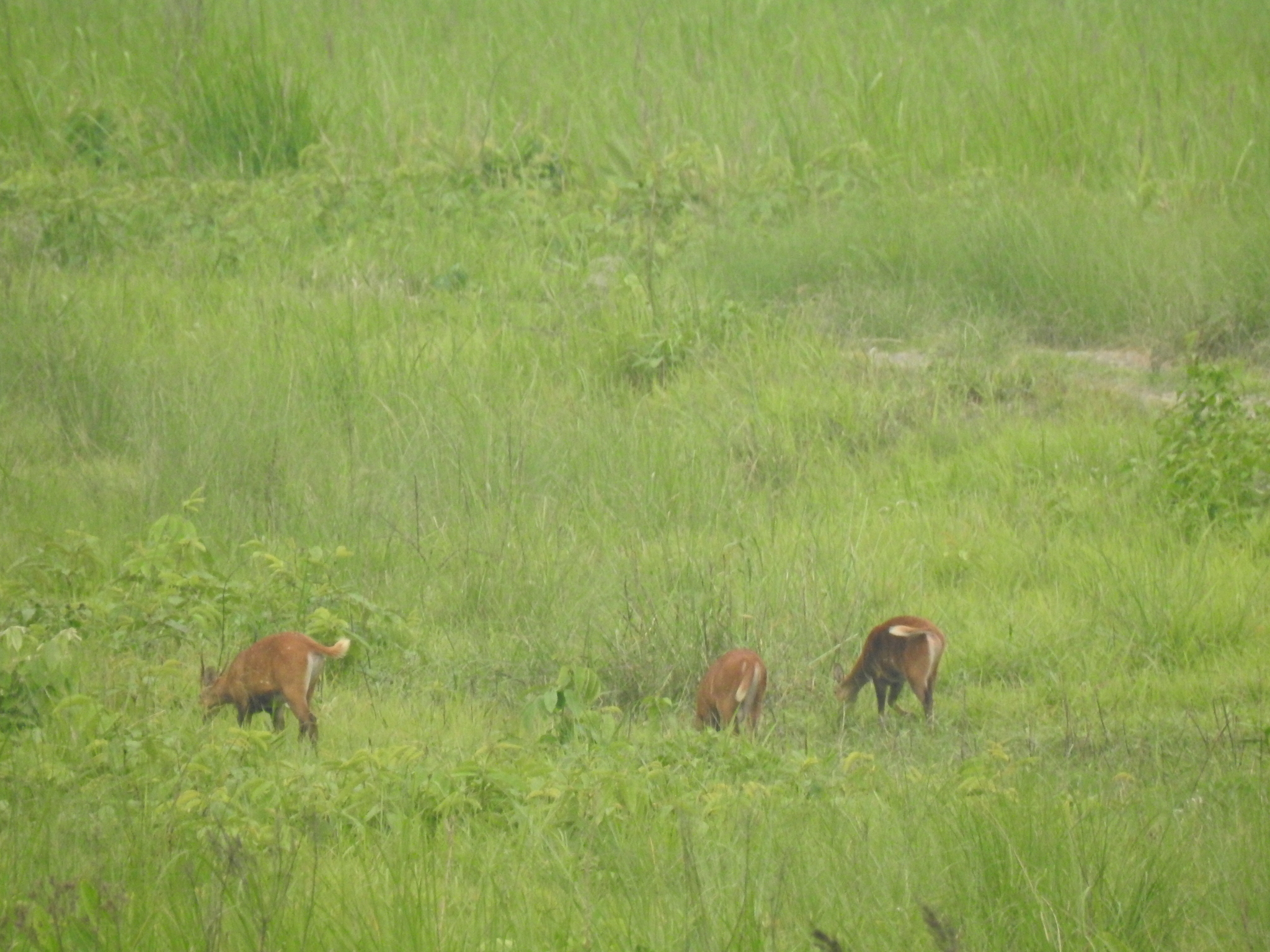
The following show caudal flagging during routine flicking of the tail vs insects:
Also cited on iNaturalistobs. 258556212
CitedAdobe Stock
Posted on June 21, 2026 01:39 AM by
milewski
The author added the following in comments beneath the original post.
Mislabelled
CitedAdobe Stock
CitedAdobe Stock
CitedAdobe Stock
Mislabelled
CitedAdobe Stock
CitedAdobe Stock
Different subspecies
CitedAdobe Stock
CitedAdobe Stock
CitedAdobe Stock
CitedAdobe Stock
CitedAdobe Stock
CitedAdobe Stock
Tibial flagg?
CitedAdobe Stock
CitedAdobe Stock
CitedAdobe Stock
CitedAdobe Stock
CitedAdobe Stock
CitedAdobe Stock
Pedal flagg in Axis axis
CitedAdobe Stock
CitedAdobe Stock
CitedAdobe Stock
CitedAdobe Stock
CitedAdobe Stock
CitedAdobe Stock
CitedAdobe Stock
CitedAdobe Stock
Mislabelled
CitedAdobe Stock
CitedAdobe Stock
CitedAdobe Stock
CitedAdobe Stock
CitedAdobe Stock
Excellent illustration of caudal flagging during defecation, in Axis porcinus porcinus:
CitedAdobe Stock
CitedAdobe Stock
Shift, mislabelled
CitedAdobe Stock
CitedAdobe Stock
Shift to auriculonota
CitedAdobe Stock
CitedAdobe Stock
CitedAdobe Stock
Citedferalscan.org.au
Citedmammalogy.org
Citedmammalogy.org
Citedupload.wikimedia.org
Conversation with Gemini
Which are the best literature references to the fact that Axis porcinus erects the tail in antipredator alarm? Supply full references.
The antipredator behavior of the hog deer (Axis porcinus)—specifically its tendency to run with its head held low while erecting its tail to flash the conspicuous white underside as an alarm signal—is documented in several foundational mammalogical and ethological texts.
The definitive literature references detailing this specific behavioral mechanism include:
- The Primary Field Monograph
- Reference: Schaller, G. B. (1967). The Deer and the Tiger: A Study of Wildlife in India. University of Chicago Press.
Context: Dr. George Schaller’s landmark field study offers some of the earliest and most detailed ethological data on the ungulates of the Indian subcontinent. He explicitly notes the flight mechanics and alarm postures of Axis porcinus, contrasting its low, trotting gait and erect tail flagging with the behavior of the sympatric chital (Axis axis).
- The Comprehensive Taxonomic & Behavioral Authority
- Reference: Geist, V. (1998). Deer of the World: Their Evolution, Behavior, and Ecology. Stackpole Books.
Context: Valerius Geist provides exhaustive species profiles for the family Cervidae. In his profile on the hog deer, he highlights its unique defensive adaptations, explaining that when alarmed or fleeing a predator, individuals run independently (rather than in cohesive herds) while holding the tail straight up to expose the white visual “flag” to trailing conspecifics or the predator itself.
- The Classic Regional Mammalogy Reference
- Reference: Prater, S. H. (1971). The Book of Indian Animals (3rd ed.). Bombay Natural History Society.
Context: This standard reference text on South Asian mammals characterizes the field identification and behavioral quirks of the hog deer. Prater writes that when startled, the species characteristically bolts with a rigid, hog-like carriage, immediately lifting its tail to show the white underside as a clear alarm signal.
Gemini is AI and can make mistakes.
Which are the best literature references to the fact that Axis porcinus erects the tail in antipredator alarm? Supply full references.
The specific statement that Axis porcinus erects or raises the tail in antipredator alarm is surprisingly poorly documented in the primary scientific literature. Most modern accounts repeat the observation without citing an original behavioural study. The best references, ranked by evidential value, are the following.
- The Ecology of the Hog Deer in Royal Chitwan National Park, Nepal (best primary reference)
- Dhungel, S. K. & O’Gara, B. W. (1991).
- The Ecology of the Hog Deer in Royal Chitwan National Park, Nepal. Wildlife Monographs, 119, 1–40.
This is the classic monograph on the species and remains the principal behavioural reference. It describes alarm behaviour, including barking and conspicuous display of the white underside of the tail during flight, and is the strongest primary source for antipredator behaviour.
- The Whitehead Encyclopedia of Deer
- Whitehead, G. K. (1993).
- The Whitehead Encyclopedia of Deer. Shrewsbury: Swan Hill Press.
Whitehead notes that the hog deer:
raises the tail to expose the conspicuous white underside when alarmed,
making this one of the standard reference works explicitly mentioning tail erection.
- The Book of Indian Animals
- Prater, S. H. (1971).
- The Book of Indian Animals (3rd ed.). Bombay Natural History Society & Oxford University Press, Delhi.
Prater describes the characteristic alarm posture of the species, noting the raised tail exposing its white underside while fleeing.
- Notes on the Behavior of Hog Deer in an Enclosure
- Miller, R. (1975).
- “Notes on the behavior of hog deer in an enclosure.”
- Natural History Bulletin of the Siam Society, 26(1–2), 105–132.
This is one of the few dedicated behavioural papers on the species. Although largely descriptive, it includes observations of alert and escape behaviour and is therefore one of the most useful primary references.
- Animal Diversity Web account for Axis porcinus
- Michelin, A.
- Axis porcinus (hog deer). Animal Diversity Web.
It explicitly states:
“When threatened, they raise their tail to expose white hairs, alerting others to danger.”
Although this is a tertiary source rather than original research, it accurately summarizes the accepted behavioural description.
- Australian identification guides
- The Australian invasive-deer identification literature also uses the behaviour diagnostically:
“The tail is usually raised into an upright position when the deer is alerted, showing the white tip and underside of the tail.”
This statement appears in management literature because the behaviour is conspicuous and useful for field identification.
Assessment of the evidence
The existence of tail erection (tail flagging) in antipredator alarm is well established, but it has not received the focused experimental treatment that exists for species such as Odocoileus virginianus or several gazelles. Instead, it is documented mainly in:
species monographs,
natural-history books,
descriptive behavioural observations, and
field identification manuals.
Among these, Dhungel & O’Gara (1991) is the strongest scientific reference, followed by Whitehead (1993) and Miller (1975). These are the references I would recommend citing in a scholarly treatment of antipredator tail erection in Axis porcinus.
CitedFacebook
CitediStock
CitedShutterstock
Citedelements.envato.com
CitedYouTube
CitedYouTube
CitedYouTube
Gemini
MY QUESTION
Does stotting occur in Axis porcinus? Quote in detail from Mungall (2007). Supply full references.
ANSWER FROM GEMINI
No, stotting does not occur in the hog deer (Axis porcinus). Instead of the high, stiff-legged bouncing gait (stotting) characteristic of certain open-country ungulates like blackbuck or gazelles, the hog deer utilizes a distinct, low-headed flight mechanism adapted for dense undergrowth.
Locomotor Behavior and Flight Style
In her definitive reference Exotic Animal Field Guide: Nonnative Hoofed Mammals in the United States, Elizabeth Cary Mungall notes that the common name “hog deer” is directly derived from this unique running posture. When startled, Axis porcinus drops its head below the line of its back and scurries or gallops through gaps in the brush rather than leaping over obstacles.
Mungall (2007) details this behavior in the species account:
“The name hog deer comes from the way this animal runs. When fleeing danger, a hog deer holds its head low and hangs it slightly forward, trailing it rather than holding it high like most other deer. Instead of leaping over obstacles, the hog deer ducks under or weaves through them in the manner of a wild hog.”
This low-slung, rapid locomotion allows the deer to exploit tunnels and paths through tall grass and thickets where a stotting or high-bounding gait would cause them to become entangled or highly visible to predators.
References
Mungall, E. C. (2007). Exotic animal field guide: Nonnative hoofed mammals in the United States. Texas A&M University Press.
Chatgpt
MY QUESTION
Does stotting occur in Axis porcinus? Supply full references.
ANSWER FROM CHATGPT
There is no convincing evidence that true stotting (pronking) has been documented in Axis porcinus.
Indeed, the available literature points in the opposite direction: hog deer are repeatedly described as escaping by running with the head held low, rather than by the high, stiff-legged leaps characteristic of stotting.
Evidence
The standard behavioural description of the species states:
“If water is not available, they run, with a trotting gait, with their head held low, instead of leaping like other cervids.”
It further notes that their principal alarm display is tail-raising, exposing the white underside while giving warning barks.
This running style is, in fact, the origin of the English name “hog deer”, reflecting a pig-like dash through dense vegetation rather than the bounding escape typical of many other cervids.
Comparison with true stotting
Stotting (pronking) is defined as a series of jumps in which all four feet leave the ground simultaneously while the legs remain relatively stiff. It has been well documented in:
Antidorcas marsupialis,
Eudorcas thomsonii,
Antilocapra americana,
and several North American deer,
but the standard reviews of stotting do not include Axis porcinus.
Behavioural studies of hog deer
Recent observational studies of hog deer in both wild and captive settings describe activity budgets, feeding, resting, locomotion, courtship, and social behaviour, but do not report stotting or pronking. Instead, locomotion consists of walking, trotting, running, and ordinary movement.
Conclusion
Based on the available literature:
True stotting/pronking has not been reported in Axis porcinus.
The species instead exhibits a characteristic low-headed, pig-like running gait when fleeing predators.
Its principal antipredator display is raising the tail to expose the white underside, often accompanied by alarm barking.
Full references
Caro, T. M. (1986). The functions of stotting: a review of the hypotheses. Animal Behaviour, 34, 649–662..
Myers, P. (2001). Axis porcinus (hog deer). Animal Diversity Web, University of Michigan Museum of Zoology. Describes antipredator behaviour as running “with a trotting gait, with their head held low, instead of leaping like other cervids,” and notes tail-raising alarm display.
Harischandra, G. P., Dayawansa, N., Chandrasekara, C. M. K. N. K., & Perera, P. K. P. (2024). A Behavioral Study of an Isolated, Semi-Wild, Critically Endangered Hog Deer (Axis porcinus) Population in Honduwa Island Sanctuary in the Wet Zone of Sri Lanka. Proceedings of the International Forestry and Environment Symposium, 28.
Madhumadhawa, R. C., Fernando, B. V. P., Perera, P. K. P., Atapattu, K. N., Jayasinghe, C., & Withanage, N. (2024). Habitat Preference and Behaviour of Critically Endangered Hog Deer (Axis porcinus) in Honduwa Island Sanctuary in Southwest Sri Lanka. Proceedings of the International Forestry and Environment Symposium, 28.
Ali, I., Noreen, M., Rasheed, S., Hussain, A., & Saeed, I. (2024). Studies on the Behavioral Impact of Visitors and Feeding Management in Hog Deer (Axis porcinus) Kept at Jallo Wildlife Park, Lahore. Biological and Clinical Sciences Research Journal.
CitedDOI
END OF TRANSCRIPT FROM AI
Citedbusiness.qld.gov.au
Citedaltinawildlife.com
CitediStock
CitediStock
CitediStock
CitediStock
CitediStock
Citedwatatunga.co.uk
Citednature.com
CitedDreamstime
Shift
CitedDreamstime
CitedDreamstime
Hyelaphus porcinus annamiticus
CitedDreamstime
CitedDreamstime
CitedDreamstime
CitedDreamstime
CitedDreamstime
CitedDreamstime
CitedDreamstime
CitedDreamstime
CitedDreamstime
CitedDreamstime
CitedDreamstime
CitedDreamstime
CitedDreamstime
CitedDreamstime
CitedDreamstime
CitedDreamstime
CitedDreamstime
Gemini
MY QUESTION
Describe the differences in colouration between sspp. porcinus and annamiticus of Axis porcinus = Hyelaphus porcinus. Supply full references.
ANSWER FROM GEMINI
The phenotypic differentiation between the two extant subspecies of the hog deer—the nominate western form (Hyelaphus porcinus porcinus or Axis porcinus porcinus) and the Indochinese eastern form (Hyelaphus porcinus annamiticus or Axis porcinus annamiticus)—rests primarily on overall pelage tone, the presence of hair-banding (speckling), and seasonal variation in spotting.
Coloration Differences
General Pelage and Under-Tones
Hyelaphus porcinus porcinus: Exhibits a more cryptic, olive-grey to dull yellowish-brown base coloration. The summer coat shifts to a richer reddish-brown or chestnut-brown, while the winter coat darkens to a uniform, dense dark brown or muddy charcoal-grey.
Hyelaphus porcinus annamiticus: Noticeably brighter and more saturated. The base coloration is distinctly ochreous (golden-ochre to warm orange-brown) throughout the year, appearing far less dull or grayish than the nominate subspecies.
Speckling (Hair Banding)
H. p. porcinus: The individual guard hairs display prominent, contrasting agouti-type banding (alternating dark and light bands). This gives the coat a distinct “speckled” or grizzled texture under close inspection.
H. p. annamiticus: Lacks this pronounced speckling. The horizontal bands on individual hairs are remarkably faint or completely uniform, resulting in a cleaner, smoother, and more solid presentation of the ochre base coat.
Ontogenetic and Seasonal Spotting
Both subspecies display bold white spots as fawns.
In adults, summer maculation (spotting) varies. H. p. porcinus frequently retains faint or variable rows of light-colored spots flanking the dark dorsal stripe from the shoulders to the rump during the summer moult. In contrast, adult H. p. annamiticus typically presents a more uniformly solid coat with less distinct or entirely absent adult summer spotting, save for exceptional individuals or localized variations. Both retain pale to white underparts, inner thighs, and a white undertail used for alarm signaling.
Diagnostic Summary
Feature Hyelaphus porcinus porcinus Hyelaphus porcinus annamiticus
Primary Hue Dull grey-brown to olivaceous-buff; richer brown in summer. Bright, rich golden-ochre to warm orange-brown.
Coat Texture/Pattern Distinctly speckled/grizzled due to strong hair-banding. Solid, uniform appearance due to faint hair-banding.
Dorsal Lineage Comparison Flanked by variable but frequent light summer spotting. Minimal to no adult summer macro-spotting on flanks.
Primary Taxonomic References
Groves, C., & Grubb, P. (2011). Ungulate Taxonomy. Johns Hopkins University Press.
Note: Provides the explicit diagnostic contrast regarding external morphology: “A. annamiticus is much brighter; more ochery, less gray and buffy; and not speckled (this is due to the fainting banding on the hairs).”
Heude, P. M. (1888). Etudes sur les Mammifères de l’Empire Chinois. Mémoires Concernant l’Histoire Naturelle de l’Empire Chinois, 2, p. 50.
Note: The original description establishing Hyelaphus annamiticus based on phenotypic specimens from Annam (modern-day Vietnam).
Lydekker, R. (1915). Catalogue of the Ungulate Mammals in the British Museum (Natural History), Volume IV. British Museum (Natural History), London.
Note: Contains historical diagnostic reviews detailing geography and coat color transitions of mainland Southeast Asian populations (referencing Cervus porcinus hecki and annamiticus synonyms).
Pocock, R. I. (1943). The larger deer of British India. Journal of the Bombay Natural History Society, 43, 553–572.
Note: Critical baseline work on the pelage, cranial traits, and geographic variations of the genus Axis (Hyelaphus) within the Indo-Malayan zone.
END OF TRANSCRIPT FROM AI
The following are additional illustrations of the ventral accentuation (dark underscoring) – as opposed to countershading – in Hyelaphus porcinus annamiticus:
CitedDreamstime
CitedDreamstime
CitedDreamstime
CitedDreamstime
CitedDreamstime
Muntiacus, mislabelled
CitedDreamstime
CitedDreamstime
CitedDreamstime
CitedDreamstime
CitedDreamstime