
Some feathered reptiles evolved into birds, but others flew in parallel right until all dinosaurs died.

Prof. Mumblebard claims: “Flapping flight has only evolved thrice in the entire history of the vertebrates: in pterosaurs, in bats, and in birds. Because pterosaurs were not dinosaurs, the only dinosaurs that flew were avian or paravian, i.e. birds and their transitional ancestors. Any feathers grown by other dinosaurs – in clades separate from the origin of birds – served thermoregulation and perhaps gliding, but not flapping flight.”
Robin and the Honey Badger respond: “No dinosaur converged with pterosaurs, bats or birds in the abbreviation of the bony tail. However, certain true dinosaurs – including Archaeopteryx itself – used flapping flight despite being neither birds nor on the evolutionary path to birds. These persistently long-tailed dinosaurs add a new, fourth Class to the list of vertebrates that evolved flapping flight in their own right.
Biologists have underplayed flight in ‘non-avian’ dinosaurs for two reasons. Firstly, Archaeopteryx was initially interpreted as a ‘bird’ when Darwinists needed to show a missing link; misinterpretation turned into dogma as Neo-Darwinists continued to shoehorn what was more likely a dromaeosaur into an avian lineage. Secondly, the extremely reduced bony tail which defines all true Aves – and crucially distinguishes birds from feathered dinosaurs – has been brushed aside in the emphasis on wing feathers in the fossil record. Feathered wings have been assumed to signify ‘bird’, without sober scrutiny of whether the tails of winged dinosaurs qualify them as avian.
We now know that the clade including Xiaotingia, Archaeopteryx, Microraptor, and Rahonavis lasted 90 million years. This means that the flying dinosaurs – contrary to being merely transitional – actually resisted the revolution in other dinosaurs during the Jurassic and Cretaceous.
Once we put aside previous assumptions, the evidence suggests that ‘non-avian’ dinosaurs evolved true flight and would have persisted in their flapping even if all birds had become extinct in the early Cretaceous. These persistently long-tailed, feathered, flying dinosaurs – including Archaeopteryx – deserve a new name: plumosaurs.”
***
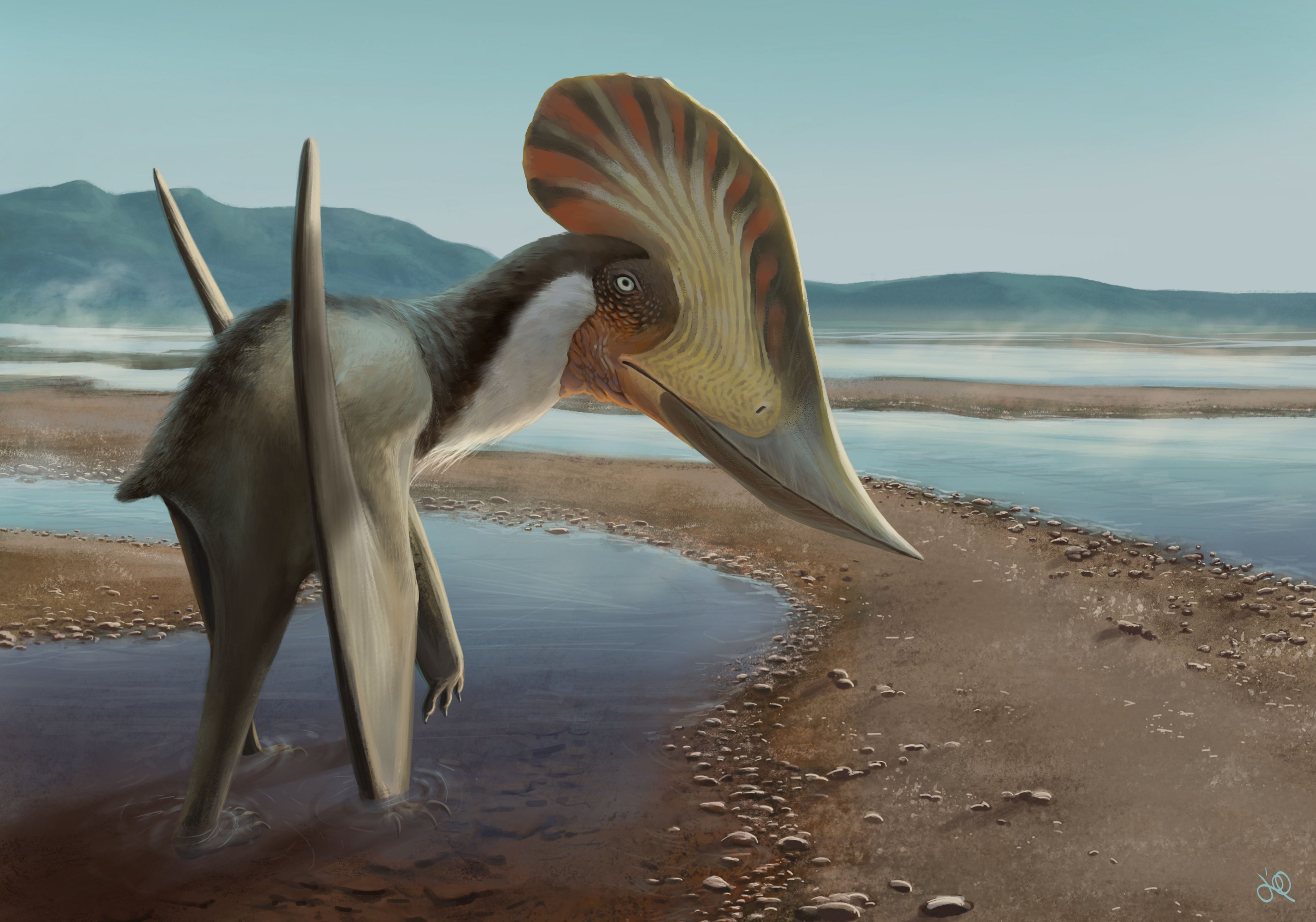
Featured image: Life reconstruction of Kariridraco dianae (a genus of pterosaur) by Gabriela M. Cerqueira, Mateus A.C. Santos, Maikon F. Marks, Juliana M. Sayão, and Felipe L. Pinheiro (CC BY 4.0, Kariridraco)