
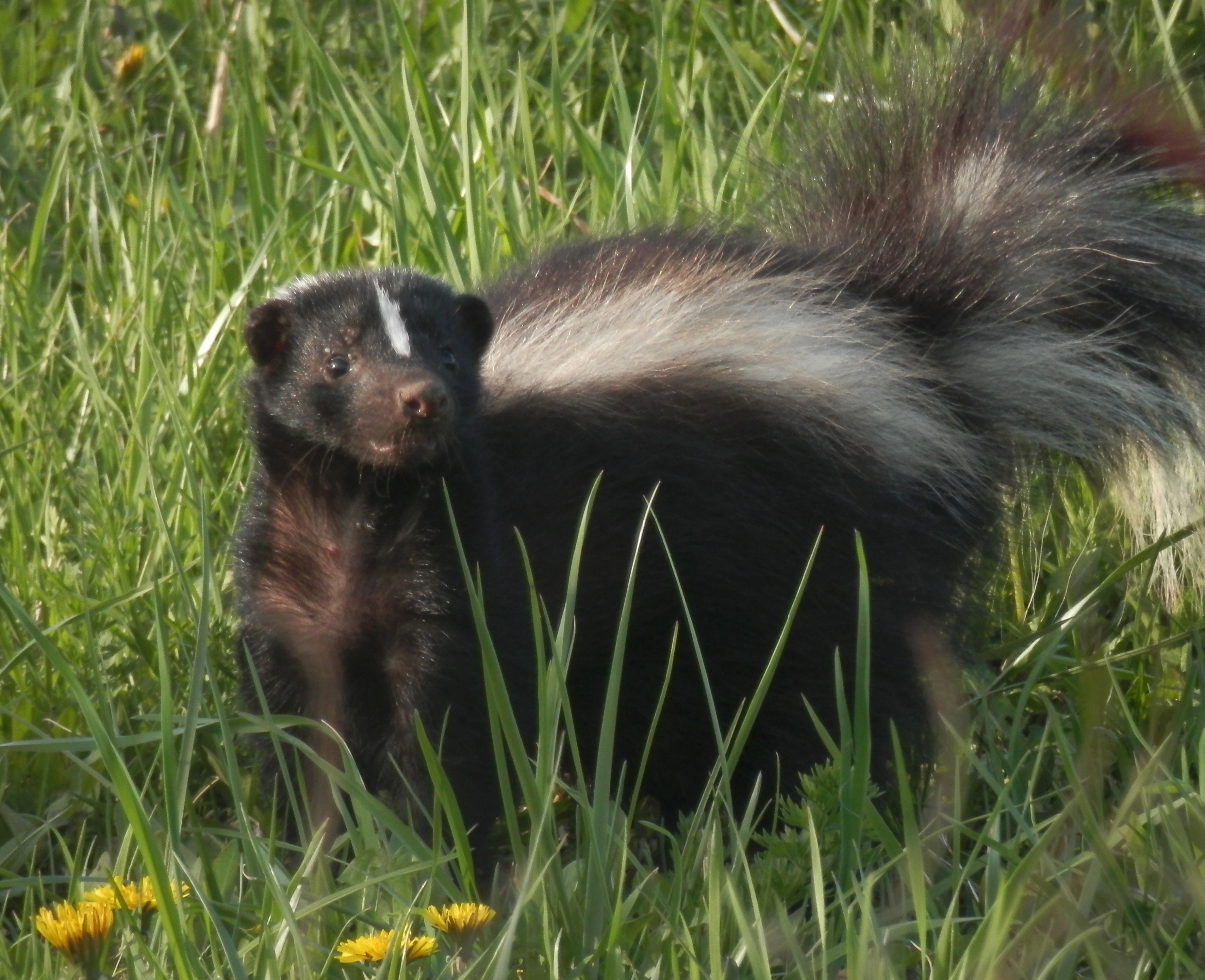
Did human ascent preclude skunk survival?

Prof. Mumblebard claims: “In the New World, the skunk family is widespread from central Canada in the north to Patagonia in the south. By contrast, in the Old World this family is restricted to equatorial southeast Asia. There are no Eurasian counterparts for the large, cold-tolerant skunks of North and South America. This vagary of evolutionary histories and continental biogeography needs not have a particular explanation in ecological or adaptive terms.”
Robin and the Honey Badger respond: “We know from the fossil record that the skunk family originated in Eurasia, whence it spread to the Americas in the Miocene. Therefore, it’s clear that skunks have become extinct on the entire mainland of the Old World in contrast to their survival in the New World. The crucial difference between Eurasia and the Americas is that humans evolved in the former, whereas Homo sapiens only reached the latter at the end of the Pleistocene. The defensive strategy of skunks works against predators such as bears, which depend on smell for foraging and thus cannot risk harm to their olfactory organ by attacking skunks. However, this chemical defence would have been relatively inept against early humans, who could kill skunks from a safe distance with projectile weapons, and would find the spray of skunks unappetising but not disabling. Given that skunks living in seasonally cold climates tend to become fat in the autumn, early humans would have had particular incentives to hunt large skunks outside of the tropics. It seems likely that skunks were extirpated from most of mainland Eurasia by human predation in the late Pliocene or early Pleistocene, several million years ago. If so, this would provide the earliest example of the regional extinction of a whole family of mammals by humans.”

***
Featured image: A striped skunk (Mephitis mephitis) by Ryan Hodnett (CC BY-SA 4.0, Striped skunk)