
A stalker that also signals
The kekebero (Canis simensis) is a stalking carnivore, which eats mainly rodents.
The speciesTaxon page·Video 1·Video 2
This species approaches its prey stealthily by day, on high-altitude meadows in Ethiopia.
Therefore, the inconspicuousness of its overall colouration is unsurprising.
However, where the kekebero differs from most other Canidae, instead resembling certain antelopes and deer, is in its pedal and caudal flaggs. These make this species particularly photogenic.
The pattern in front, and the pattern behind
The pattern on the face, throat and chest disrupts the approaching figure, making the predator inconspicuous to the prey it faces during stalking.
CitediStock 1·iStock 2·iStock 3
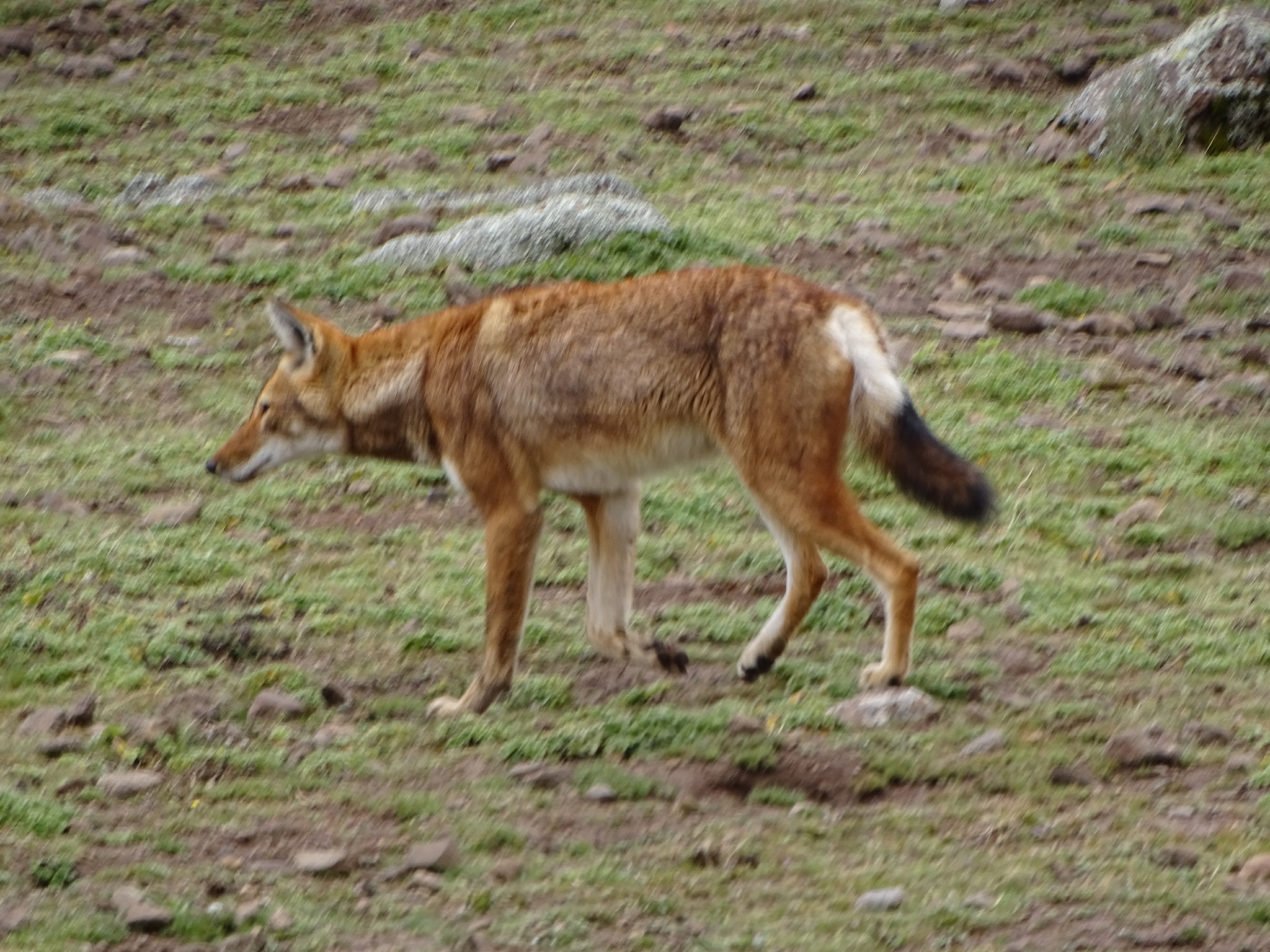
However, the pattern on the hindquarters is bolder.
Also citedFlickr·Africa Image Library
This pattern is not striking enough to reveal the stationary figure. However, it becomes eye-catching when the animal moves. I would therefore call this a caudal flagg.
MovementVideo
The caudal flagg of the kekebero presumably functions for social cohesion in this slightly gregarious species. However, it differs from most caudal flaggs in ungulates in that the tail is not routinely raised or wagged.
The kekebero is not unique in possessing this particular pattern on the hindquarters. Some individuals of, for example, the side-striped jackal (Lupulella adusta) have a comparable pattern.
CitedWikimedia Commons·Fandom
A pedal flagg on the forelegs
What is unique to the kekebero is a pedal flagg, restricted to the forelegs.
The inner surface of the lower foreleg is anomalously pale, and tends to shine on pasture free of obstructing herbage. This applies particularly in the slanting light of morning and late afternoon.
The pedal flagg lacks the dark emphasis seen on the tail. However, it is conspicuous enough to accentuate the movement of walking or trotting.
The pedal flagg aids social cohesion more secretively than does the caudal flagg. This is because the signal is low on the figure, and on a surface that tends to be shaded when the sun is brightest.
CitediStock 1·iStock 2·iStock 3·iStock 4·age fotostock·Wild Kratts wiki·Animalia
The following shows the caudal and pedal flaggs working together on the moving figures.
CitediStock
The following show a different type of caudal flagg, seen in some individuals of the side-striped jackal (Lupulella adusta).
CitedForestry Images·Snapshot Serengeti·Invasive.org
I have explained the origin of the common name ‘kekebero’ in a comment on another post.
CitedCommentary on the Serengeti jackal
One pattern, three functions
Canis aureus shows subtle horizontal banding on the front of the neck and chest, hypothetically functioning as camouflage.
CitedShutterstock 1·Shutterstock 2·Shutterstock 3·Shutterstock 4·Shutterstock 5·123RF·Alamy
Canis simensis shows the same pattern shifted at least partly to a function of self-advertisement.
CitedGetty·Depositphotos·Shutterstock 1·Shutterstock 2·Shutterstock 3
Canis familiaris ‘black-and-tan’ shows the same pattern shifted largely to self-advertisement.
CitedShutterstock 1·Shutterstock 2·Shutterstock 3·Shutterstock 4·Shutterstock 5·Bil-Jac·Dogster
Comparisons among jackals
Self-advertisement, partly by virtue of colouration, in Lupulella mesomelas mesomelas.
CitedBigstock·Adobe Stock·Science Photo Library
The following show the colouration on the hindquarters: a subtle, ambivalent pattern in Lupulella mesomelas mesomelas, and a lack of pattern in Canis anthus bea.