
Plasticfruits seriesPart 1·Part 2·Part 3·Part 4·Part 5·Part 6·Part 7·Part 8
Muraltia, a parallel in an unrelated family
In part 1, I described how evolutionarily plastic the fruits are in a mainly southern African genus (Osteospermum) of daisies (Asteraceae).
Also seeSANBI, fleshy and dry fruits
The genus Muraltia (Polygalaceae) is geographically and ecologically similar to Osteospermum, despite belonging to an unrelated family.
PhylogenyScienceDirect
Like Osteospermum, Muraltia contains wind-dispersed, ant-dispersed and vertebrate-dispersed species.
MuraltiaWikipedia·Flora of South Australia·Fact sheet·PlantZAfrica
Dispersal by antsJSTOR 1·JSTOR 2
Although in both genera the seeds have food-bodies attached to them to attract ants, these take different forms.
In Osteospermum the food-body is the mesocarp that envelops the seed. By contrast, in Muraltia it is a handle-like edible attachment called an elaiosome.
ElaiosomeExplanation·Wikipedia
Dispersal by tortoises
The bright-hued fleshy fruits of Muraltia spinosa and Muraltia scoparia seem adapted for dispersal and sowing mainly by tortoises such as Chersina angulata. Unlike those of Osteospermum moniliferum, they remain crisp when ripe, and tend to fall to the ground.
Chersina angulataWikipedia
Muraltia spinosaSystematic Botany·PlantZAfrica·Taxon page
Muraltia scopariaPlantZAfrica·Taxon page
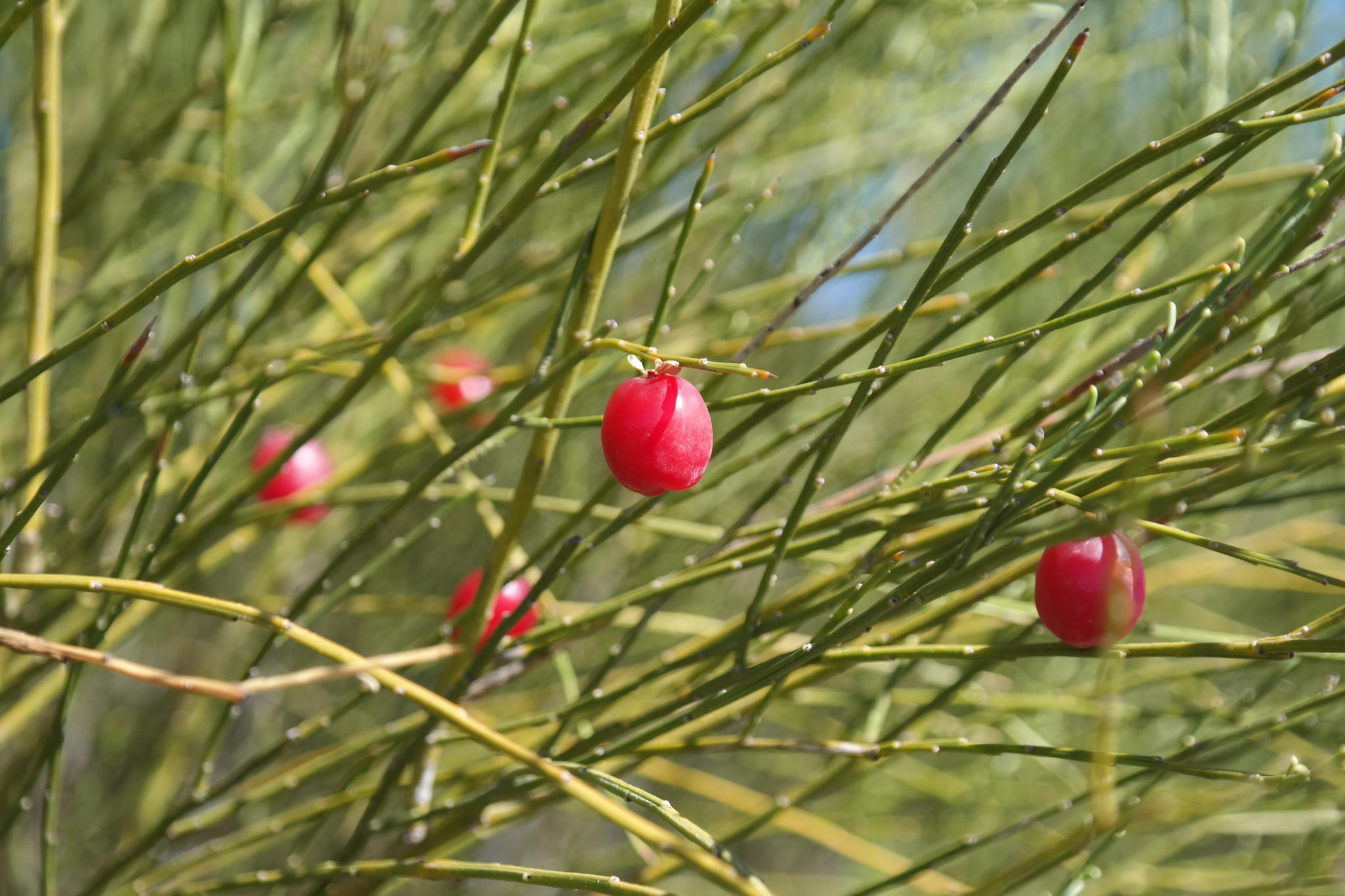
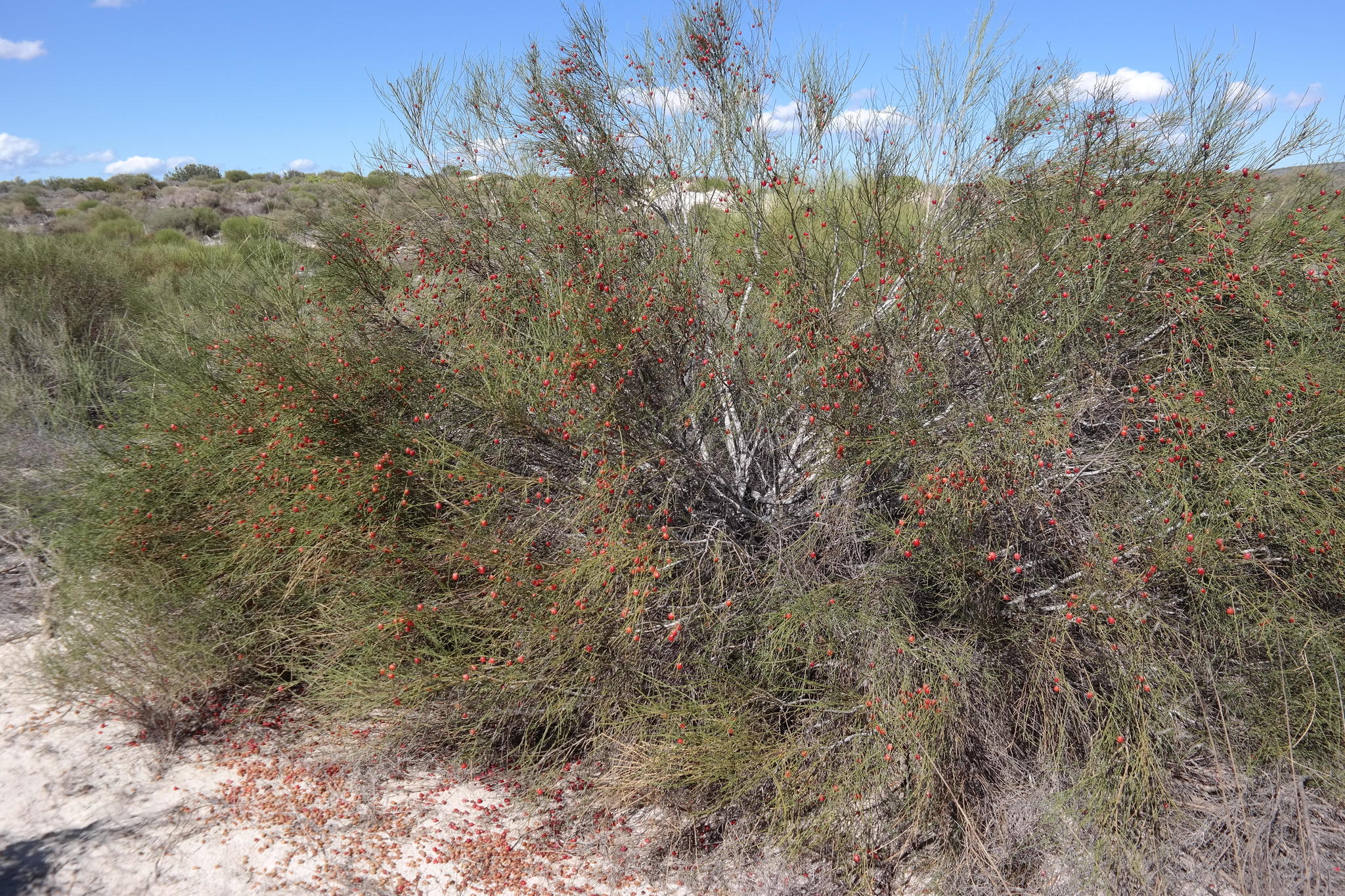
In the case of both Muraltia and Osteospermum, the species dispersed and sown by vertebrates were, for several decades, classified as separate genera, based on the form of the fruits. This has since been corrected, with the taxonomic realisation that fruits are too adaptable to be reliable indicators of phylogenetic affinity.
CitedInclusion of Nylandtia in Muraltia
An ecologically odd species
Muraltia spinosa is ecologically unusual, within the context of the Cape Floristic Region and the Fynbos biome.
ContextCape Floristic Region·Fynbos·Fleshy fruits at Oorlogskloof
This is because M. spinosa shows an odd combination of
- succeeding in at least four different situations, viz. certain forms of renosterveld (on clay-rich soils on both shale and dolerite), marginally on certain forms of nama karoo (on dolerite), certain forms of fynbos (on coarse, deep sand), and certain forms of strandveld (on calcareous coastal sand),
- aphyllousness and retention of leaves,
- sclerophylly (in the form of photosynthetic stems) and fleshy fruits,
- semi-spinescence (in the form of the same photosynthetic stems) and tolerance of nutrient-poor soils with more-or-less flammable vegetation,
- semi-spinescence and evergreenness,
- succulent fruits and some tolerance to wildfire, and
- endozoochory and reptilian (rather than avian) agents of dispersal and sowing.
tonyrebelo noted that bietou is bird-dispersed — bulbuls certainly love it — and added Chironia baccifera, whose fruit resembles that of Nylandtia (Muraltia) spinosa, is also produced in quantity, and is likewise a ‘tortoise berry’.
ludwig_muller noted that Columba arquatrix is also very fond of bietou berries.
Also cited on iNaturalistobs. 34237602
jeremygilmore has seen chacma baboon faeces around the Cape Peninsula consisting of almost 100% bietoubos seeds, and various birds swarming the bushes in the garden at fruiting.
In 2001, I visited the Silhouette Hiking Trail, near Sutherland. The landform was boulder-outcrops of dolerite. The vegetation was Nama Karoo with scattered Dicerothamnus rhinocerotis, and was devoid of succulents other than geophytes. In this situation, Muraltia spinosa occurred as scattered individuals, shaped by browsing.
CitedSilhouette Hiking Trail·Sutherland·Taxonomy of Passerina·Oorlogskloof comments